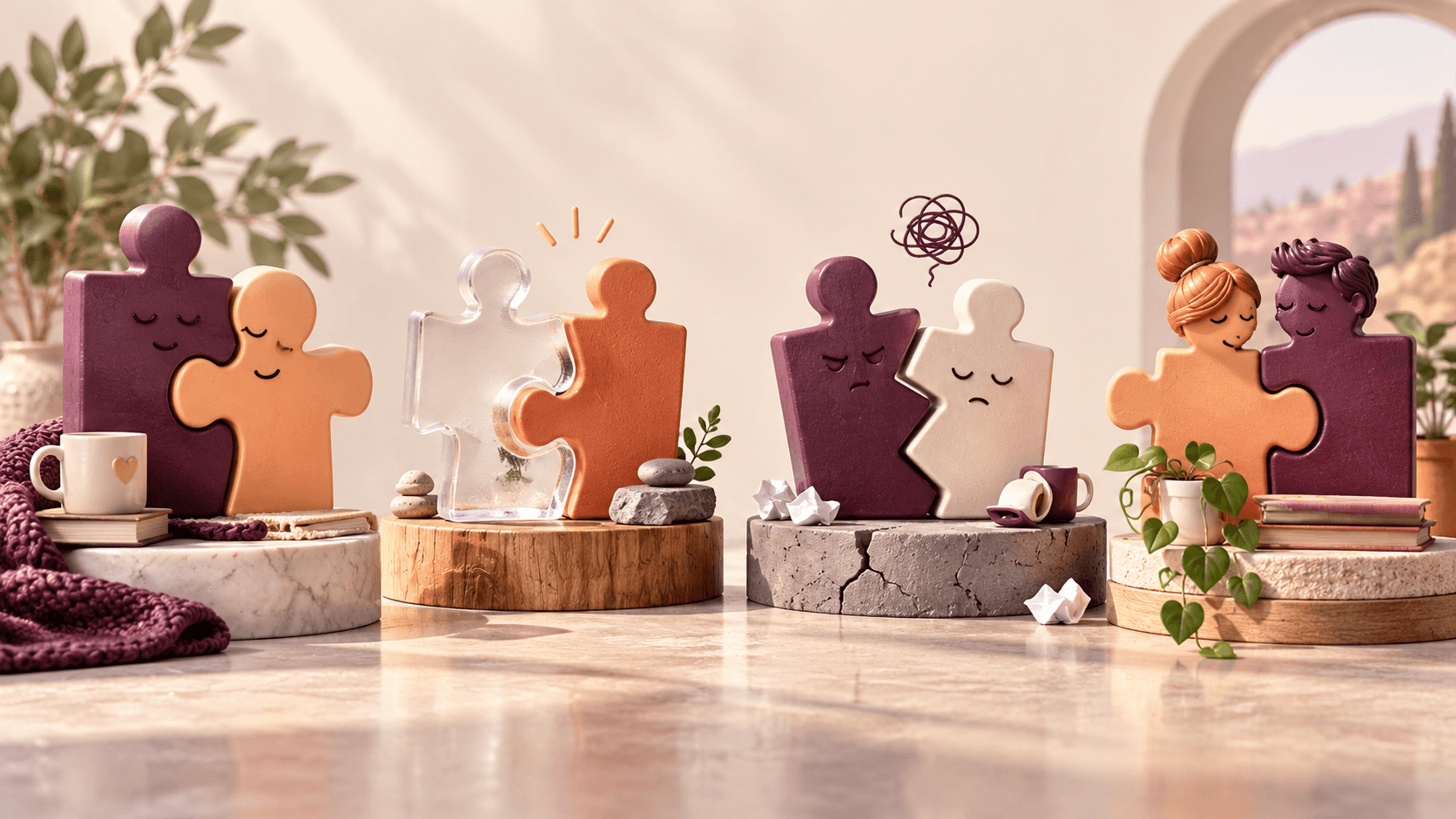
Search for attachment style compatibility and you'll find neat charts: secure with secure is perfect, anxious with avoidant is doomed, and everything else sits somewhere in between. It's tidy, shareable and only partly true.
The research tells a more hopeful story. Some pairings do face predictable struggles, but your own attachment security, and the way the two of you treat each other day to day, matter more than which boxes you tick. Here's how each pairing tends to work, which ones struggle, and why.
A quick refresher on the styles
Adult attachment is usually measured on two dimensions: anxiety (worry about rejection and whether you matter) and avoidance (discomfort with closeness and depending on others). Combining them gives four broad styles:
- Secure: low anxiety, low avoidance. Comfortable with closeness and with independence.
- Anxious: high anxiety, low avoidance. Wants closeness, worries about losing it.
- Dismissive avoidant: low anxiety, high avoidance. Values self-reliance, keeps some distance.
- Fearful avoidant: high on both. Wants closeness but finds it frightening.
These are tendencies on a spectrum, not fixed categories. For a fuller introduction, see the four attachment styles explained.
What research says about compatibility
Your own attachment matters most
Across many studies, people with higher attachment anxiety or avoidance tend to report lower relationship satisfaction, whoever they're with. Your partner's style adds something, but your own security does a lot of the work.
The relationship itself matters even more
A large 2020 study led by Samantha Joel pooled data from 43 couples studies and used machine learning to find the strongest predictors of relationship quality. Individual traits, including attachment, did predict satisfaction. But how people perceived the relationship itself, such as their sense of commitment, appreciation and a partner's responsiveness, predicted far more. Notably, information from the partner, including their traits, added relatively little beyond each person's own view of the relationship.
A secure partner can help
Research by Jeffry Simpson, Nickola Overall and colleagues describes "partner buffering": the ways a responsive partner can soothe an insecure partner's fears in the moment, for example by offering reassurance to an anxious partner or giving an avoidant partner a sense of space. Over time, these experiences may help insecure partners feel safer.
Stable isn't the same as happy
In a well-known 1994 study, Lee Kirkpatrick and Keith Davis followed dating couples and found that relationships between anxious women and avoidant men were surprisingly stable over time, even though partners reported lower satisfaction. A pairing that lasts isn't always a pairing that feels good.
A pairing-by-pairing guide
| Pairing | Common strengths | Common struggle | Outlook |
|---|---|---|---|
| Secure and secure | Open communication, easy repair | Can get complacent | Usually strong |
| Secure and anxious | Secure partner offers steady reassurance | Anxious partner may test or seek a lot of reassurance | Good, often helps the anxious partner settle |
| Secure and avoidant | Secure partner respects space without punishing it | Secure partner may feel shut out | Good with patience on both sides |
| Anxious and avoidant | Strong early chemistry | The pursue-withdraw cycle | Hard but workable with awareness |
| Anxious and anxious | Lots of closeness and attention | Shared worries can escalate | Workable with steady routines |
| Avoidant and avoidant | Calm, low conflict, respect for independence | Drifting into parallel lives | Stable but may lack intimacy |
| Fearful avoidant and anyone | Deep capacity for connection | Hot-and-cold swings | Most helped by a secure, patient partner |
These outlooks are generalisations. Any pairing can thrive, and any pairing can struggle.
If you're in a secure and insecure pairing, a useful question isn't "Are we compatible?" but "Is the steadiness rubbing off, or wearing thin?" Buffering tends to work best when the secure partner feels appreciated and the insecure partner is working on their side too. Otherwise reassurance can start to feel like a full-time job.
Which pairings struggle most, and why
Anxious and avoidant
This is the pairing most often described as difficult. Each partner's way of coping triggers the other's fear: the anxious partner pursues for reassurance, the avoidant partner withdraws for space, and the cycle feeds itself. Our deep dive on the anxious-avoidant trap explains how to break it.
Fearful avoidant with another insecure style
Because fearful avoidance combines a longing for closeness with a fear of it, it can clash with both anxious and avoidant partners. With an anxious partner, the push-pull can become intense. With an avoidant partner, both may retreat at the same time.
Two insecure partners of the same style
Two anxious partners can escalate each other's worries, as we cover in two anxious partners: dream match or double trouble?. Two avoidant partners rarely fight but can slowly drift apart. Neither is doomed, but both need deliberate habits.
What makes any pairing work
Whatever your combination, the same few ingredients show up again and again in relationships that feel good:
- Responsiveness. Noticing and answering each other's bids for attention, even small ones.
- Repair. Coming back together after conflict, rather than leaving things unresolved.
- Named needs. Saying "I need reassurance" or "I need an hour to myself" rather than hoping it's guessed.
- Respect for both closeness and space. Neither need is treated as a flaw.
- Willingness to grow. Both partners work on their own patterns rather than waiting for the other to change.
That last point matters because attachment styles can shift. Many people move towards security over time through supportive relationships and self-awareness. If you want to compare notes, take our free attachment style test, ideally both of you, and talk through the results with curiosity rather than blame.
Does an "incompatible" match mean you should leave?
Not on its own. A compatibility chart can't tell you whether your partner is kind, whether they listen or whether you repair well after conflict, and those are the things that matter most. It's also worth remembering that an attachment test describes how you tend to feel in relationships, not who you're allowed to love.
That said, if your needs are repeatedly dismissed despite clear communication, or the relationship involves fear, control or contempt, those are reasons to take the situation seriously whatever your styles are. Talking to a qualified therapist, alone or together, can help you work out what's going on.
The bottom line
Attachment style compatibility is real but overrated. Secure partners tend to make things easier, and anxious-avoidant and fearful-avoidant pairings often face predictable struggles. But your own security and how you treat each other, especially responsiveness and repair, predict far more than your combination of styles.
FAQ
What is the best attachment style match?
Two secure partners tend to have the easiest time, and a secure partner can help an insecure one feel safer. But any pairing can work with responsiveness and good repair.
What is the worst attachment style combination?
Anxious and avoidant is often the most challenging because each partner's coping style triggers the other's fear. It is difficult, not doomed.
Can an insecure person become secure in a relationship?
Yes. Research on partner buffering and earned security suggests that consistent, responsive relationships can help people feel more secure over time.
Do both partners need to be secure for a relationship to work?
No. Many happy couples include one or two insecurely attached partners who understand their patterns and work on them together.