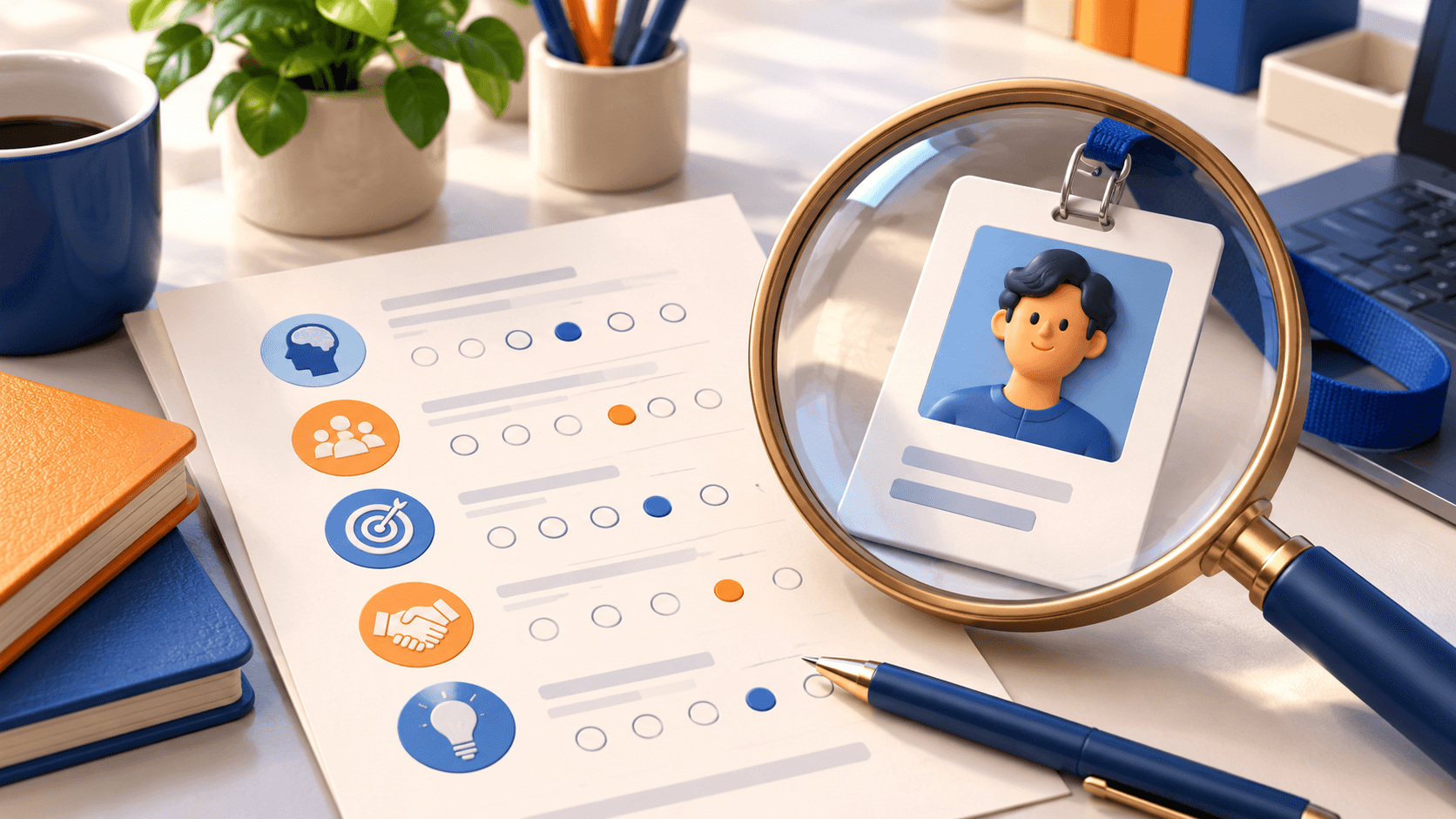
You've polished your CV, nailed the first interview, and then an email arrives: "Next step: please complete a short online assessment." It turns out to be 100 statements like "I enjoy meeting new people" and "I sometimes leave things to the last minute," each with a sliding scale from strongly disagree to strongly agree.
It's tempting to treat it like an exam with right answers. Most people try to guess what the employer wants and answer accordingly. Here is why companies actually use these tests, what they're looking for, and why answering honestly is usually your best strategy as well as the ethical one.
Why employers use personality tests
Hiring is expensive and uncertain. Interviews are useful but notoriously prone to bias: interviewers can be swayed by charm, similarity to themselves or a strong first impression. Personality assessments offer a more structured, consistent way to compare candidates.
Employers typically use them to:
- Predict how you'll approach the work, such as how organised, sociable or steady under pressure you're likely to be.
- Assess fit with the role, since a sales job and a data-analysis job reward different tendencies.
- Add structure to interviews, by suggesting areas to explore in follow-up questions.
- Support development after hiring, for coaching, team building or leadership programmes.
Good practice is to use a personality test as one piece of evidence alongside interviews, work samples and references, not as a pass-or-fail gate on its own.
What the research says about whether they work
The most influential evidence comes from a 1991 meta-analysis by Murray Barrick and Michael Mount, which looked at how the Big Five traits related to job performance. Conscientiousness stood out as the most consistent predictor across many different kinds of jobs. Other traits mattered more in particular roles, such as extraversion for sales and management.
Later research has broadly supported that picture. The predictive power of personality tests is real but modest: they help, especially combined with other methods, but they're far from a crystal ball. We look at the conscientiousness link in more detail in the personality trait that predicts success.
Which tests you might come across
| Type of assessment | What it measures | Notes |
|---|---|---|
| Big Five based questionnaires | Openness, conscientiousness, extraversion, agreeableness, neuroticism | The most research-backed approach for hiring |
| Integrity tests | Honesty, reliability, attitudes to rules | Often used for roles involving trust or money |
| Situational judgement tests | How you'd handle realistic work scenarios | Mixes personality with judgement and knowledge |
| Type-based tools (such as MBTI) | Preferences sorted into types | Popular for team building, widely discouraged for hiring decisions |
That last row matters. Type-based tools are widely used in workplaces, but their publisher's own guidance says they shouldn't be used to select candidates. Our comparison of the Big Five vs MBTI explains why trait-based measures are considered more reliable.
Why faking tends to backfire
It's true that people can inflate their scores. Studies comparing job applicants with people taking the same test for research purposes often find applicants describe themselves more positively. So why not play the game?
Tests are designed to catch it
Many workplace assessments include features that detect inconsistent or exaggerated answers, such as similar questions phrased in different ways, or statements almost nobody can honestly agree with, like "I have never been annoyed with anyone." Some use a forced-choice format, where you pick between two equally positive statements, which makes it much harder to look good on everything.
The "perfect" profile looks suspicious
If you answer "strongly agree" to every positive trait and "strongly disagree" to every negative one, the result can look unrealistic. Real people have a mix of strengths and weaknesses, and a profile with none can raise more questions than it answers.
You might get a job that doesn't suit you
Even if faking works, it can land you in a role that clashes with how you really like to work. If you describe yourself as someone who loves constant social contact when you actually need quiet focus, you may end up in a job that drains you. Our guide to personality and career fit explores why that match matters.
How to answer honestly and still show your best self
Honest doesn't mean self-sabotaging. Here are practical ways to approach these tests:
- Answer as your work self. Think about how you typically behave at work, not on holiday or at your most stressed.
- Go with your first sensible answer. Overthinking each item tends to produce more inconsistent results.
- Avoid living at the extremes. Use the strong options when they're genuinely true, not as a default.
- Be consistent. If you notice two questions that feel similar, answer them the same way unless your honest answer differs.
- Read the job description. Not to tailor your answers, but to remind yourself which genuine strengths are relevant.
- Rest beforehand. Tiredness and stress can colour how you see yourself in the moment.
What about the questions that feel like traps?
Items such as "I sometimes feel down" or "I get stressed under pressure" can feel risky. But nearly everyone agrees with them to some degree. Answering truthfully, perhaps "agree" rather than "strongly agree," is usually seen as normal. Denying all ordinary human experience is more likely to raise flags.
Your rights and how to follow up
It's reasonable to ask an employer what the assessment measures, how it will be used and whether you can see your results. Many organisations will share a summary report. In some countries, data protection rules give you further rights over personal data collected during hiring.
If you have a condition or circumstance that might affect how you complete a test, you can ask whether adjustments are available.
Practise by knowing yourself
The best preparation isn't memorising "right answers." It's understanding your own profile well enough that you can talk about it confidently in an interview. If you take our free Big Five personality test beforehand, you'll have a clearer sense of your strengths, and of the areas you might want to frame thoughtfully when they come up.
The bottom line
Employers use personality tests because they add structure to hiring and modestly predict how people approach work, with conscientiousness the most consistent predictor. Faking is detectable more often than people think, and even when it works it can land you in the wrong job. Answer as your genuine work self, consistently and without extremes, and you give both yourself and the employer the best chance of a good match.
FAQ
Can you fail a personality test for a job?
There usually aren't right or wrong answers, but your profile may be compared with what the role needs. A poor match on one test rarely decides everything, as most employers combine it with interviews and other evidence.
Should I lie on a pre-employment personality test?
It's not a good idea. Many tests detect inconsistent or exaggerated answers, and a faked profile can land you in a role that doesn't suit you.
Do employers use the Myers-Briggs for hiring?
Some do, but it's widely discouraged for selection decisions, including by its publisher. Big Five based assessments are generally considered more appropriate for hiring.