You answer twelve questions in four minutes, wait for a loading bar and learn your IQ is 142. You feel great for about an hour, until a friend mentions they got 145 on the same site after guessing half the answers. Suddenly the number feels less impressive.
Online IQ tests range from carefully built research tools to pure entertainment dressed up with official-looking graphs. The good news is that you can tell them apart. Here is what makes any IQ test accurate, six red flags that should make you ignore a result, and how to get the most honest estimate from a test you trust.
The short answer
Some online IQ tests give a reasonable estimate of your reasoning ability. Many do not. No online test is equivalent to a full clinical assessment, which is given one-on-one by a trained psychologist and samples many different abilities over an hour or more.
A good online test is best thought of as a well-made thermometer: useful, quick and roughly right, but not a full medical. A bad one is closer to a mood ring.
What makes any IQ test accurate
Psychologists judge tests on three main qualities:
- Reliability. Would you get a similar score if you took it again next week? Good tests produce consistent results.
- Validity. Does it actually measure reasoning ability, and do its scores line up with established tests and real-world outcomes?
- Norms. Your score only means something compared with a reference group. A good test compares you with a large, representative sample of people your age.
| Full clinical test (e.g. WAIS) | Good online test | Entertainment quiz | |
|---|---|---|---|
| Administered by | Trained psychologist | You, unsupervised | You, unsupervised |
| Length | Often 60 to 90 minutes | Around 15 to 40 minutes | A few minutes |
| Abilities covered | Many: verbal, memory, speed, reasoning | Usually reasoning and patterns | Often unclear |
| Norms | Large, carefully sampled | Stated and research-based | Rarely explained |
| Best use | Formal assessment | Personal estimate | Fun |
Encouragingly, researchers have built free, validated online item banks. The International Cognitive Ability Resource (ICAR), introduced by David Condon and William Revelle, was designed for exactly this purpose and has been used in large online studies. If you want the full background on test design, see our guide on how IQ tests work.
Red flags in how the test is built
1. It is far too short
Accuracy needs enough questions to separate luck from ability. A test with ten items cannot tell a 115 from a 130 with any confidence, because one lucky guess changes everything. Be sceptical of anything that finishes in under five minutes.
2. The questions test trivia, not reasoning
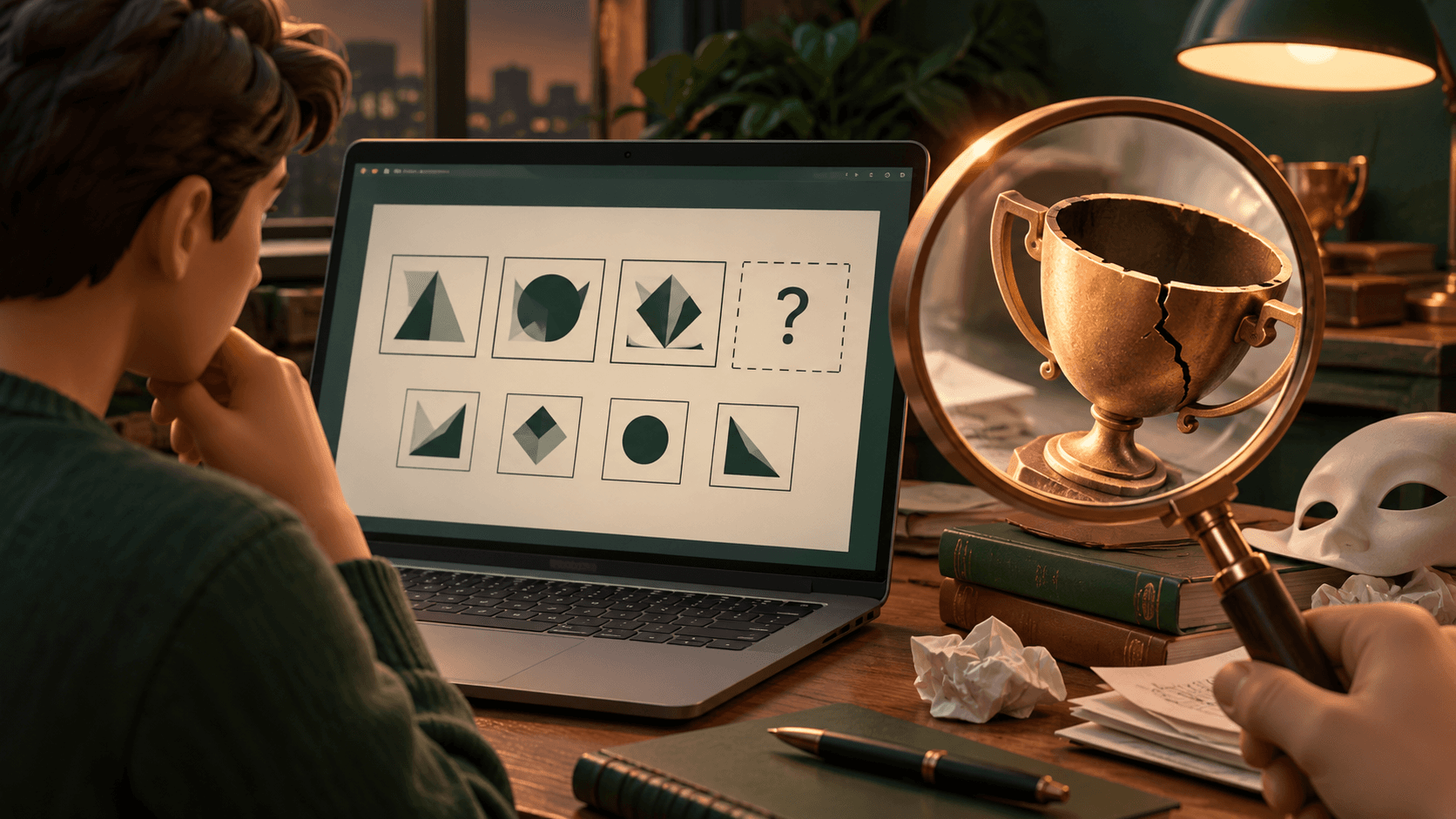
Good IQ tests focus on reasoning: matrix puzzles, number series, verbal analogies and spatial problems. If the questions are mostly general knowledge, spelling or pop culture, the test is measuring what you happen to know, not how you think. Our overview of the main types of IQ puzzles shows what genuine items look like.
3. There is no word on who you are compared with
A real IQ score is a comparison with a norm group. If a site cannot tell you, even briefly, how its scores are calculated or who they are benchmarked against, the number it gives you is essentially made up.
Red flags in how results are sold
4. Everyone scores high
Flattering scores keep people sharing and paying. A simple check: answer randomly. On a multiple-choice test with four options, pure guessing should give you a low score. If random clicking produces "above average," the test is not measuring anything.
5. It gives a precise number with grand claims
All tests have a margin of error, so honest results are presented as an estimate, ideally with a percentile and a sense of the range. Be wary of exact-looking numbers paired with claims like "official IQ certificate," "Mensa-level result" or "certified genius." No online test can qualify you for a high-IQ society or provide a formal assessment.
6. The cost appears only at the end
Some sites let you spend twenty minutes on a test, then reveal that seeing your score requires payment, sometimes in the form of a subscription that is hard to cancel. Paying for a detailed report is not a problem in itself; hiding the price until you are invested is. A trustworthy test tells you up front what is free and what is not.
What a good online test can tell you
A well-designed online test can give you:
- A reasonable estimate of your current pattern reasoning and problem-solving.
- A percentile showing roughly how you compare with others your age.
- A sense of your relative strengths, if it reports more than one score.
What it cannot do is diagnose anything, replace a professional assessment for school or legal purposes, or capture creativity, motivation and the many skills that matter outside a puzzle grid.
How to get the most accurate result
Even a good test can only measure you on the day. To give yourself a fair reading:
- Choose a quiet time when you are rested and not rushed.
- Silence your phone and close other tabs.
- Take it once and take it seriously. Retaking the same items inflates scores because you remember them.
- Read your score as a range. A few points either way is normal measurement error.
When you are ready, you can take our free IQ test. Your results, including an estimated score and percentile, are free. If you want help reading your number, our guide to what a good IQ score is explains the bell curve.
The bottom line
Online IQ tests can be accurate enough to give a useful estimate, but only if they are long enough, focus on reasoning, explain their norms and report results honestly. Short quizzes that flatter everyone, sell certificates or spring a paywall at the end are entertainment at best. Use a trustworthy test, take it under good conditions and treat the result as an estimate, not a verdict.
FAQ
Are free online IQ tests accurate?
Some are. Price is not the best guide to quality; look instead at test length, question types and whether the site explains how scores are calculated. Free research tools such as ICAR show that good tests do not have to cost money.
Why did I get a different score on another site?
Different tests use different questions, norms and scoring methods, and some are far less accurate than others. Day-to-day factors like tiredness and stress also shift scores by a few points.
Can an online IQ test replace a professional assessment?
No. Online tests can give a useful personal estimate, but formal assessments for education, work or clinical purposes need a qualified professional and a standardised test.