The first few questions feel easy. Then a grid of shapes appears with one square missing, and your mind goes perfectly blank. You stare, you guess, you move on, and you never find out what the pattern was.
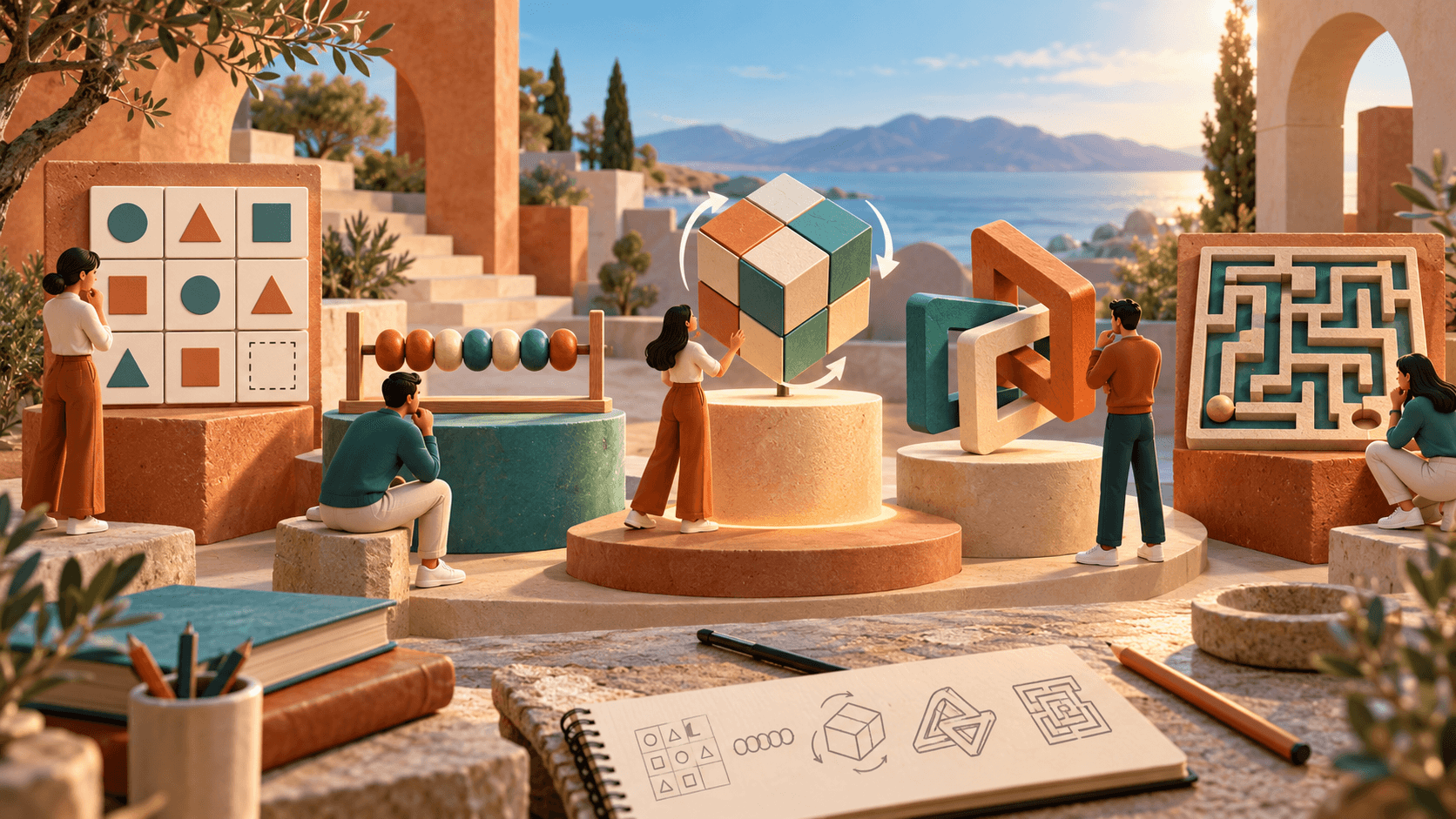
Most IQ tests are built from a handful of puzzle families, and each one has a logic you can learn to see. Knowing the types won't transform your score, but it will stop unfamiliarity from getting in the way of your real reasoning. Here are the five you'll meet most often, with an example and a practical trick for each.
Why IQ tests use puzzles at all
Puzzles let a test measure reasoning without relying too heavily on what you happened to learn at school. Most are designed to tap fluid intelligence, the ability to solve new problems, alongside some crystallised intelligence, the knowledge and vocabulary you've built up. If you want to know how the questions are chosen and scored, our guide to how IQ tests work explains the design.
Here's a quick overview of the five types:
| Puzzle type | What it mainly tests | The core trick |
|---|---|---|
| Matrix reasoning | Abstract pattern finding | Change one feature at a time |
| Number series | Numerical reasoning | Look at the gaps, not the numbers |
| Verbal analogies | Verbal reasoning, vocabulary | Say the relationship as a sentence |
| Spatial rotation | Visualising shapes in your head | Track one distinctive feature |
| Odd one out | Classification, flexible thinking | Test several properties, not just the first |
1. Matrix reasoning
You see a grid, usually three by three, of shapes or patterns with the last cell missing. Your job is to pick the piece that completes it. This is the most famous IQ puzzle type, and the basis of tests such as Raven's Progressive Matrices. Our deep dive into Raven's Progressive Matrices explains why it's so widely used.
Example: in each row, the shape carries one, then two, then three dots as you move right, and the shape itself changes from circle to square to triangle as you move down. The missing cell in the bottom right is a triangle with three dots.
The trick: don't try to see the whole pattern at once. Break the cells into features, such as shape, number, shading, size, position and rotation, and check how each one changes across a row. Then check down the columns. Most hard matrices combine two or three simple rules that run at the same time.
Also check:
- Whether one cell in each row is the sum or difference of the other two, such as lines that add or cancel out.
- Whether each feature appears exactly once per row, like a mini sudoku.
- Whether the change runs diagonally rather than across or down.
2. Number series
You're given a sequence and asked for the next number.
Example: 2, 6, 12, 20, 30, ?
The trick: stop staring at the numbers and write down the gaps between them. Here the gaps are 4, 6, 8, 10, so the next gap is 12 and the answer is 42.
If the gaps don't reveal anything, try these in order:
- Gaps between the gaps. Some series grow in a pattern that only shows on the second level.
- Multiplication or division. Check whether each number is double, triple or half the last.
- Two interleaved series. Look at every other number. In 3, 6, 4, 8, 6, 12, ? the rule alternates between "multiply by 2" and "subtract 2", so the answer is 10.
- Squares, cubes and primes. Numbers such as 1, 4, 9, 16 or 2, 3, 5, 7, 11 are popular because they're recognisable once you spot them.
3. Verbal analogies
These take the form "A is to B as C is to ?"
Example: Thermometer is to temperature as scale is to ? The answer is weight, because a thermometer measures temperature and a scale measures weight.
The trick: put the relationship between the first pair into a short sentence, then apply that exact sentence to the second pair. "A thermometer measures temperature" becomes "A scale measures ___." If more than one answer fits, make the sentence more specific.
Common relationships include part to whole, tool to function, cause to effect, opposites, and degree, such as warm to hot. Vocabulary helps here, which is why verbal items lean more on crystallised intelligence than the other types do.
4. Spatial rotation
You might be shown a 3D shape and asked which of several options is the same shape rotated, or a flat net and asked which cube it folds into.
The trick: pick one distinctive feature, such as a coloured face, an unusual notch or the point where two patterns meet, and follow only that through the rotation. Then check a second feature to confirm.
Two more tips:
- Watch for mirror images. Many wrong answers are reflections of the original, which can't be produced by rotation alone. If the handedness has flipped, rule it out.
- For cube nets, remember opposite faces. Two faces separated by one square in a straight line on the net will end up opposite each other, so they can never appear side by side on the folded cube.
People vary quite a lot in spatial ability, and it's one of the skills that tends to improve noticeably with practice on similar tasks.
5. Odd one out
You're shown a set of words, numbers or shapes and asked which doesn't belong.
Example: 2, 3, 5, 9, 11 The answer is 9, because it's the only number that isn't prime.
The trick: the first difference you notice is often a decoy. Before you answer, run through several properties, such as category, size, shape, function, number of sides, odd or even, and ask which property separates exactly one item from the others. Good test designers make sure only one rule gives a clean answer.
These puzzles reward flexible thinking, the ability to drop your first idea and look again. They overlap a lot with the broader skill covered in our article on pattern recognition.
Does practising these help?
A little, but less than many websites claim. Familiarity with the formats usually gives a modest boost, especially on your first few attempts, because you're no longer working out what the question even wants. After that, gains tend to level off. Practising specific puzzles also doesn't seem to raise general intelligence itself.
That's actually good news. It means knowing the five types mainly helps a test measure your real reasoning, instead of measuring how surprised you were. When you'd like to put that into practice, you can take our free IQ test and see how you do across a range of puzzle styles.
The bottom line
Most IQ tests draw on five puzzle families: matrices, number series, verbal analogies, spatial rotation and odd one out. Each has a simple strategy, such as checking one feature at a time, looking at the gaps or saying the relationship aloud. Learning them won't make you a genius overnight, but it will help your score reflect how you really think.
FAQ
What types of questions are on an IQ test?
Most include pattern-based puzzles like matrices and number series, verbal questions like analogies and vocabulary, spatial tasks such as mental rotation, and sometimes memory and speed tasks.
What is the hardest type of IQ puzzle?
It varies from person to person, but many people find complex matrix puzzles and spatial rotation the hardest, because they combine several rules or require holding a shape in mind.
Can I improve my IQ score by practising puzzles?
Practice usually gives a small boost from familiarity, mostly on early attempts. It helps you show your ability more accurately rather than increasing underlying intelligence.
Are online IQ puzzles the same as real IQ tests?
Many use the same puzzle types, but a full IQ test also needs careful scoring against a large norm group. Puzzles on their own are good practice rather than a measurement.