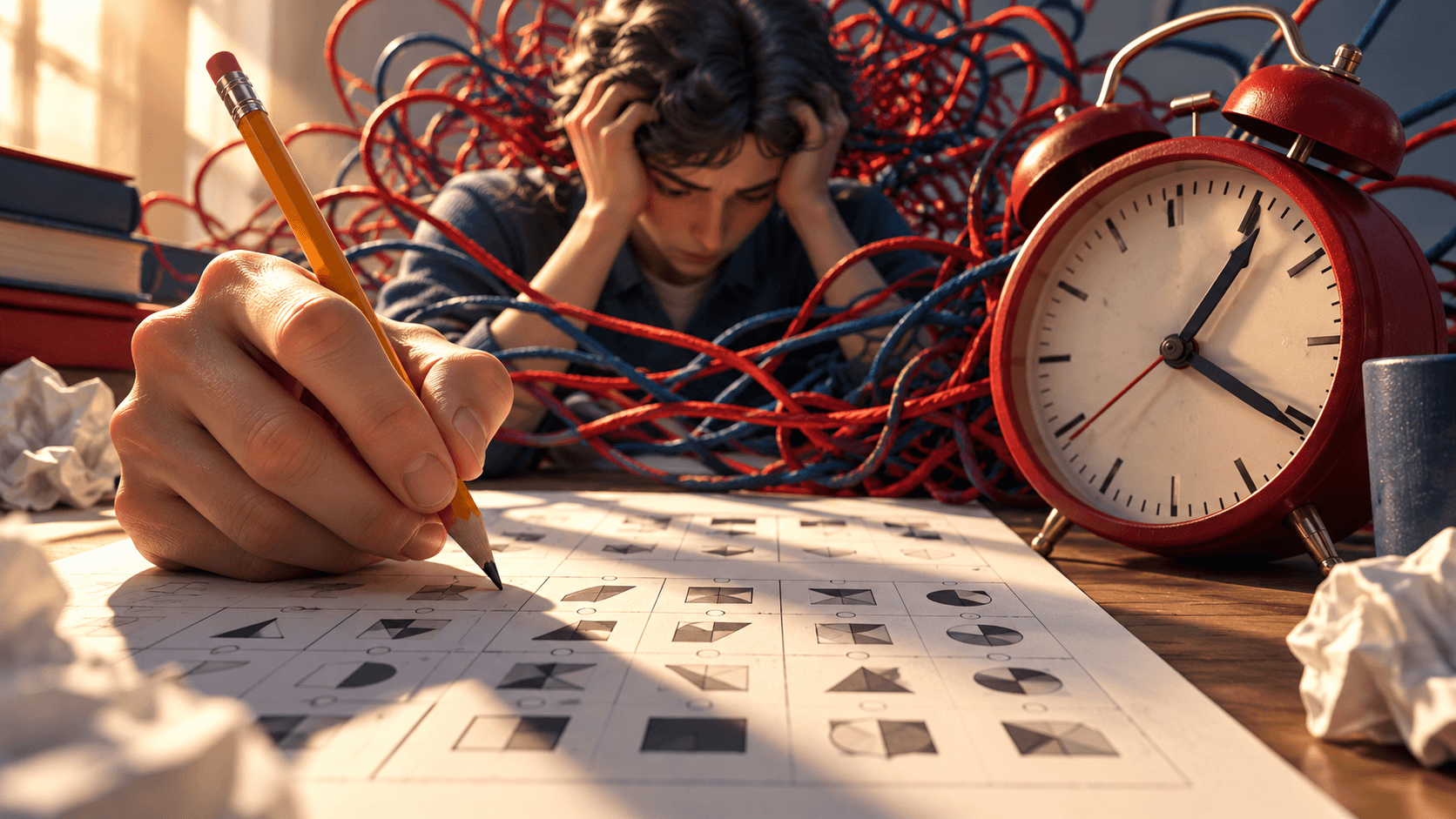
You knew the answer. You'd known it all week. Then the clock started, your heart began to thump, and the answer simply wasn't there. Ten minutes after you walked out, it came back as if nothing had happened.
That isn't a sign you're less capable than you thought. It's one of the best-documented effects in cognitive psychology: anxiety competes with your thinking for the same limited mental resources. This guide explains how that happens, how much it can shift a score, and what research suggests actually helps.
What test anxiety actually is
Test anxiety is the stress some people feel before and during evaluations, from exams to job assessments to IQ tests. It's extremely common, and it exists on a spectrum, from mild jitters to a level that makes it hard to think at all. It isn't a disorder, and feeling it doesn't mean anything is wrong with you.
Researchers have long split it into two parts:
- Worry: the mental side. Thoughts like "I'm going to fail," "Everyone else finds this easy," or "What will this score say about me?"
- Emotionality: the physical side. A racing heart, sweaty palms, a tight stomach, shaky hands.
Of the two, worry is usually the bigger problem for performance. A thumping heart is unpleasant, but it's the anxious thoughts that do most of the damage.
How nerves hijack your thinking
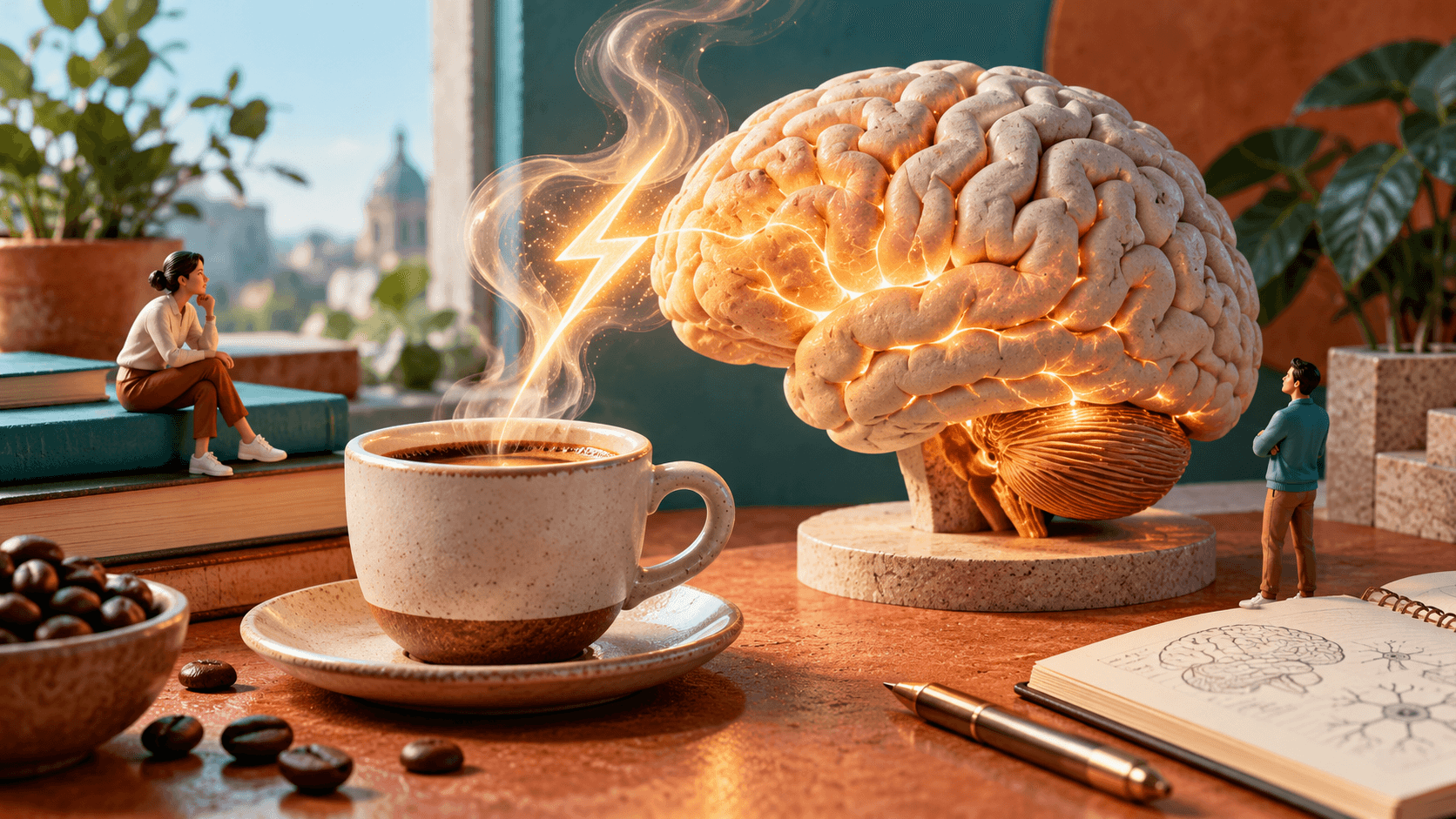
To solve a reasoning problem, you need working memory: the mental workspace where you hold information and manipulate it. It's powerful but small, able to juggle only a few things at once. Our guide to working memory explains why it plays such a big role in reasoning.
When you're anxious, worrying thoughts move into that workspace and take up room. The puzzle now has to share space with "I'm running out of time" and "I'm so bad at this." Less capacity is left for the actual problem.
This idea is formalised in attentional control theory, developed by Michael Eysenck and colleagues. It proposes that anxiety pulls attention towards threats, including internal ones like worrying thoughts, and makes it harder to stay focused on the task. Anxious people can often still get the answer, but it costs them more effort and time.
Sian Beilock's research on "choking under pressure" adds a twist: people with the most working memory capacity can sometimes be hit hardest, because they rely on that capacity for complex strategies, and pressure takes it away.
How much can anxiety lower a score?
A large meta-analysis by Ray Hembree in 1988 pooled hundreds of studies and found that higher test anxiety was consistently linked to lower performance across many kinds of tests. Crucially, it also found that treatments that reduced anxiety tended to improve performance, which suggests the anxiety itself was doing some of the damage rather than simply reflecting lower ability.
The size of the effect varies a lot from person to person. For someone with mild nerves, it might make no noticeable difference. For someone who freezes, it can make a single result look clearly lower than their usual ability.
| Anxiety level | What it tends to do | Likely effect on a score |
|---|---|---|
| Low to mild | Alertness, some focus | Little or none, sometimes helpful |
| Moderate | Distracting thoughts, rushed answers | Small dip on harder items |
| High | Blanking, rereading, abandoning questions | Can noticeably understate ability |
This is one reason IQ results are best treated as estimates with a margin of error. A single score captures your performance on that day, in that state, not a fixed number stamped on you for life.
Why IQ tests feel especially stressful
Plenty of people who handle exams fine still tense up at an IQ test. A few reasons:
- The stakes feel personal. An exam measures what you studied. An IQ test feels like it measures you.
- Timers. Many tests are timed, and the visible countdown is a magnet for worry.
- Unfamiliar formats. Matrix puzzles and number series can feel strange if you haven't seen them before.
- Hard items are deliberate. Good tests include questions most people can't answer, so struggling is built in. Anxious test-takers often read that struggle as failure.
Simply knowing about point four can help. If a question feels impossible, that may be by design.
Five evidence-based ways to stay sharp
1. Write your worries down first
In a study by Gerardo Ramirez and Sian Beilock, students who spent about ten minutes writing about their worries just before an exam performed better than anxious students who didn't. The idea is that putting worries on paper frees up working memory.
2. Reframe the racing heart
Research by Jeremy Jamieson and colleagues found that telling students that physical arousal can help performance led to better results on a maths test. Instead of "I'm panicking," try "My body is getting ready."
3. Get familiar with the format
Uncertainty fuels anxiety. Practising a few sample puzzles reduces the surprise factor. Our article on whether you can practise for an IQ test explains how much this shifts scores, and why it's modest.
4. Slow your breathing
A few slow breaths with a longer exhale can take the edge off the physical side of anxiety. It won't silence worry entirely, but it makes it quieter.
5. Skip and return
If a question stalls you, move on. Getting stuck feeds the worry loop. Coming back with fresh eyes often works better.
Taking an IQ test online
Online tests can be a gentler starting point because you choose the time and place. Pick a quiet moment when you're rested, not a stressful lunch break. It's also worth choosing a test that's well built in the first place: our guide to whether online IQ tests are accurate shows what to look for.
When you feel calm and ready, you can take our free IQ test at your own pace and see how your reasoning holds up without the exam-hall pressure.
If test anxiety is affecting your studies or career, or nerves spill into other parts of life, a counsellor or therapist can help. Approaches based on cognitive behavioural techniques are often used for it.
The bottom line
Nerves can lower your score because anxious thoughts crowd into the same working memory you need to solve problems. Research shows this effect is real, that it varies from person to person, and that simple steps like writing down worries, reframing arousal and getting familiar with the format can help. A nervous score is a snapshot of a stressful moment, not a measure of your ceiling.
FAQ
Can anxiety make you score lower on an IQ test?
Yes. Anxiety can take up working memory and attention, which makes reasoning problems harder to solve, especially under time pressure.
Is test anxiety a sign of low intelligence?
No. Test anxiety occurs across the whole range of ability, and some research suggests people with high working memory can be particularly affected by pressure.
How do I stop blanking during a test?
Move on from a stuck question, take a few slow breaths, and come back later. Writing down your worries before the test can also reduce blanking for some people.
Should I retake an IQ test if I was nervous?
If you felt very anxious, a later retake in calmer conditions may give a better estimate. Keep in mind that scores can rise slightly with familiarity, so treat any result as a range.