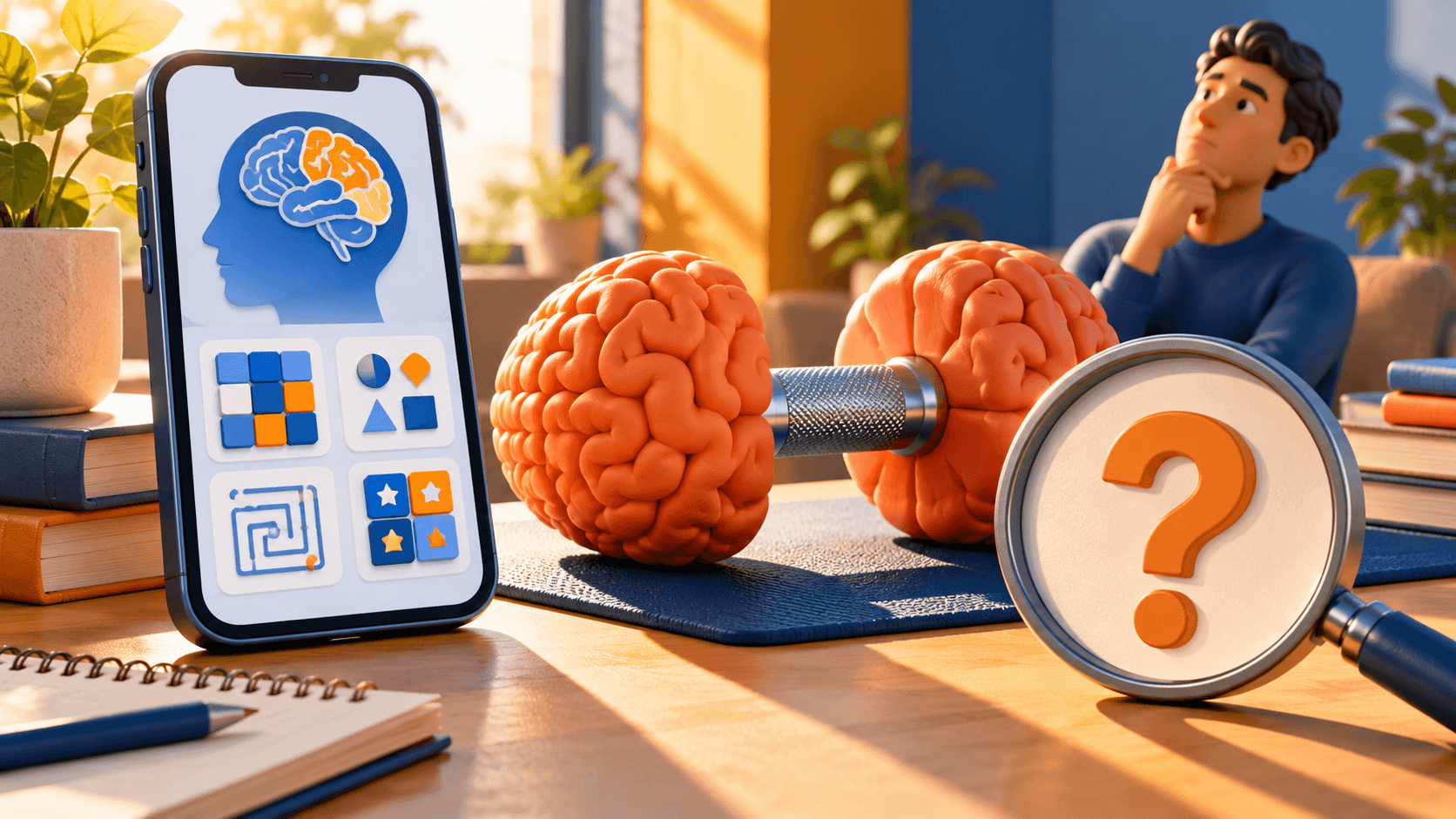
Ten minutes a day, a streak counter, a chart showing your "brain score" climbing week after week. Brain training apps are satisfying to use, and the progress feels real because it is: you really do get faster and more accurate at the games.
The question that matters is whether that improvement makes you smarter outside the app: sharper at work, better at reasoning, less forgetful. After years of large studies, the honest answer is mostly no, with a couple of interesting exceptions. Here's what the research shows, and what to do instead if you want a sharper mind.
What brain training apps promise
Most apps offer short games that target memory, attention, processing speed or mental flexibility. The pitch is that practising these core skills will strengthen your mind in general, helping with school, work, everyday memory and even ageing.
The idea draws on neuroplasticity, the brain's ability to change with experience. Neuroplasticity is real. The problem is the leap from "your brain changes when you practise something" to "practising this game will improve everything else".
The key question: transfer
Psychologists use the word transfer to describe whether training on one task improves performance on something else.
- Near transfer means getting better at tasks very similar to the one you trained on.
- Far transfer means getting better at different, broader abilities, such as reasoning, school results or job performance.
Far transfer is what brain training apps are really selling. It's also where the evidence is weakest.
| Type of improvement | Example | What the evidence shows |
|---|---|---|
| Trained task | Getting better at the app's memory game | Strong and consistent |
| Near transfer | Improving on a similar memory task you didn't train on | Sometimes, usually modest |
| Far transfer | Better reasoning, grades, work performance or IQ | Weak or absent in most rigorous studies |
What the big studies found
The BBC experiment
In 2010, Adrian Owen and colleagues published a study in Nature with more than 11,000 participants recruited through a BBC programme. People trained online several times a week for six weeks on tasks designed to improve reasoning, memory, planning and attention. They improved on the tasks they practised, but showed no meaningful gains on untrained tests, even ones that were closely related.
Working memory training
Working memory, your ability to hold and work with information in mind, is closely tied to reasoning. In 2008, a study using the "n-back" task suggested that working memory training might boost fluid intelligence, sparking a wave of interest. Later research was far less encouraging. A 2013 meta-analysis by Monica Melby-Lervåg and Charles Hulme found short-term gains on similar tasks but no convincing evidence of far transfer. Our post on working memory explains why this skill matters so much.
Taken together, these studies point the same way. Practice makes you better at what you practise, and the benefits tend to stay close to home.
The reviews, the letters and a fine
As studies piled up, researchers tried to take stock of the whole field.
The 2016 review
In 2016, Daniel Simons and colleagues published a detailed review of the evidence, including studies cited by brain training companies. They found plenty of evidence that training improves performance on the trained tasks, less for closely related tasks, and little that it improves everyday cognitive performance. They also noted that many studies had design weaknesses, such as small samples or weak control groups.
Competing open letters
The debate also spilled into public view. In 2014, the Stanford Center on Longevity and the Max Planck Institute for Human Development released a statement signed by dozens of scientists warning that claims made for brain games were often exaggerated. Another group of researchers responded with an open letter of their own, arguing that some forms of training showed promise.
The Lumosity settlement
In 2016, the US Federal Trade Commission reached a settlement with Lumos Labs, the company behind Lumosity, over claims that its games could improve performance at work and school and delay age-related decline. The company agreed to pay $2 million and change its advertising.
The possible exceptions
The picture isn't entirely negative.
Speed training in older adults
The ACTIVE trial, a large study in the United States that began in the late 1990s, gave older adults training in memory, reasoning or processing speed. Each group improved on the ability it trained, and some gains lasted for years. Some follow-up analyses reported links with everyday functioning, especially for speed training, though these findings are debated and the effects on daily life were modest.
Motivation and enjoyment
If a brain game gets you into a regular habit of focused mental effort, and you enjoy it, that has some value. Just be aware that expectations can colour results. A 2016 study by Cyrus Foroughi and colleagues found that people recruited with an advert promising that brain training would make them smarter showed higher scores on intelligence tests after a short session, while people recruited with a neutral advert did not. That looks a lot like a placebo effect.
What actually helps your thinking
If your goal is a sharper mind, the strongest evidence points to broad, real-world habits rather than games:
- Learn complex things. A language, an instrument, coding or a demanding subject engages many abilities at once.
- Stay in education or keep studying. Years of schooling are linked to higher IQ scores, and natural experiments suggest part of this is causal.
- Move your body. Regular aerobic exercise is linked to better cognitive function. See the 20-minute habit that sharpens your thinking.
- Protect your sleep. Poor sleep reliably impairs attention, memory and reasoning.
- Stay socially engaged. Conversation and shared activities give your mind a varied, demanding workout.
For a broader look at what can and can't shift your score, read can you increase your IQ?.
Should you delete the app?
Not necessarily. If you enjoy it, it can be a pleasant way to spend ten minutes, and getting better at a game is satisfying. Just don't expect it to raise your IQ, transform your memory or protect you from the effects of ageing. Think of it like a crossword: fun, mildly engaging and mostly good for getting better at crosswords.
If you're curious about your current reasoning skills, take our free IQ test for a baseline. Then put your energy into the habits above rather than chasing a higher in-app score.
The bottom line
Brain training apps reliably make you better at the games they contain, but large studies and reviews have found little evidence that those gains spread to general intelligence or everyday thinking. Learning challenging skills, exercising, sleeping well and staying socially engaged are far better bets for a sharper mind.
FAQ
Do brain training apps increase IQ?
Most rigorous studies find no meaningful increase in IQ or general intelligence. People improve on the trained games, but those gains rarely transfer to other abilities.
Is Lumosity scientifically proven?
No. In 2016, the US Federal Trade Commission alleged that the company lacked evidence for claims that its games improved everyday performance, and the company agreed to a $2 million settlement.
Are any brain games worth playing?
They can be enjoyable and mildly engaging, and some forms of speed training have shown benefits on trained skills in older adults. Just don't expect broad gains in intelligence.
What is the best way to keep your brain sharp?
Evidence favours learning challenging new skills, regular exercise, good sleep and social engagement over app-based games.