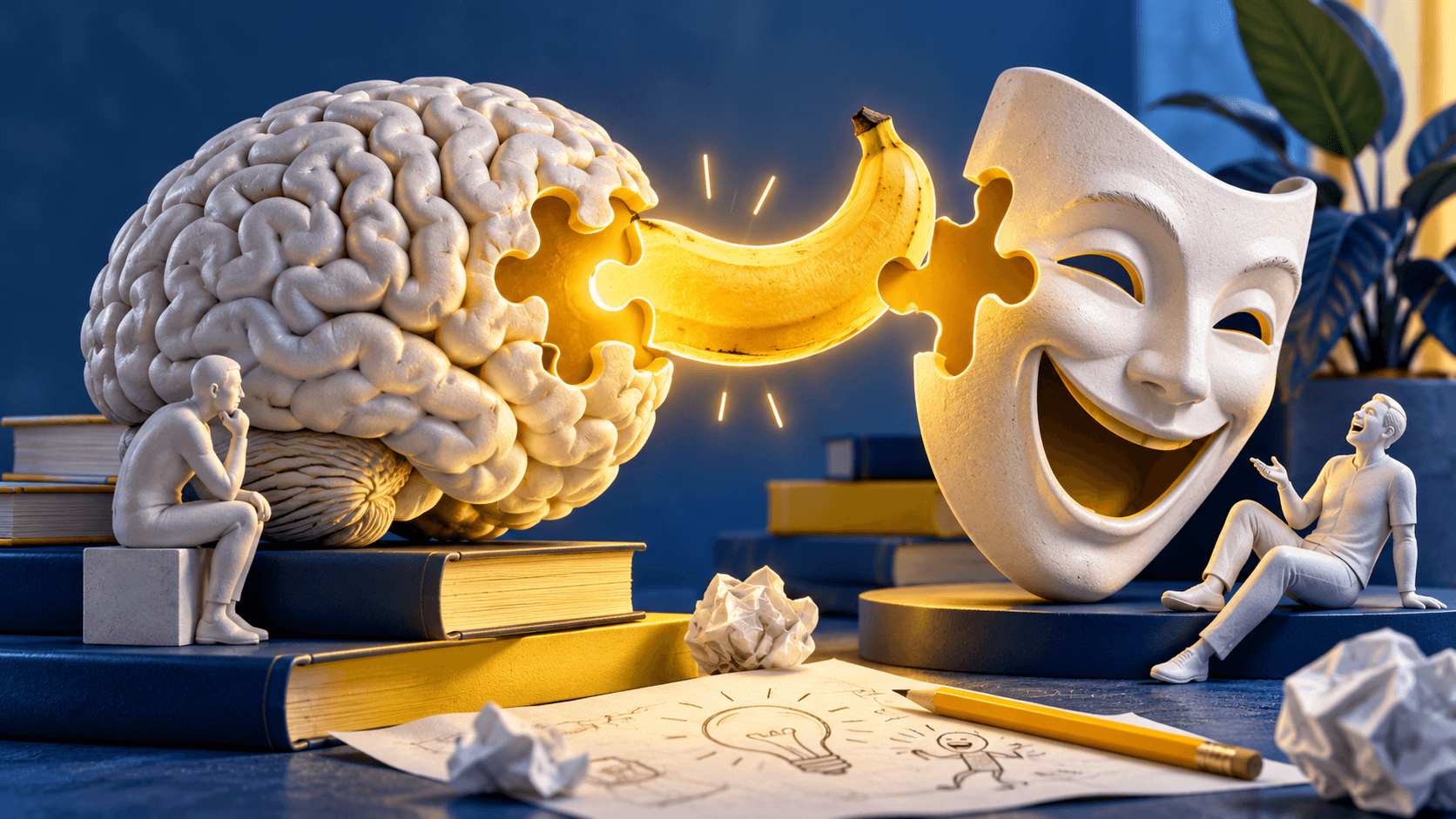
Some people can find the joke in almost anything. They spot the absurd detail nobody else noticed, twist a phrase mid-sentence, and land the line at exactly the right moment. It's hard not to suspect that something sharp is going on behind it.
That suspicion turns out to be partly right. Studies do link humour with intelligence, particularly verbal intelligence. But the link is moderate, it depends on what kind of humour you mean, and it doesn't mean the quieter person in the room is any less clever. Here's what the research actually shows.
Why humour might need brainpower
Making a good joke is a surprisingly demanding mental task. You have to understand a situation, spot an unexpected connection, predict how other people will see it, and phrase it quickly and precisely.
Understanding humour takes effort too. Many jokes depend on resolving an incongruity: something doesn't fit, and then suddenly it does. That "aha" moment draws on the same kinds of skills involved in reasoning and problem-solving.
Timing adds another layer. In conversation, a joke usually has to arrive within a second or two to work, which means drawing on vocabulary, knowledge and quick reasoning all at once. A clever line that arrives five minutes late rarely gets the laugh.
So it's reasonable to expect a link. The question is how strong it is.
What the research found
Humour production and verbal intelligence
One of the best-known studies, by Gil Greengross and Geoffrey Miller in 2011, asked participants to write funny captions for cartoons and had independent judges rate them. People with higher verbal intelligence tended to produce funnier captions. In turn, people rated as funnier reported somewhat more mating success, which fits Miller's idea that humour may work partly as a signal of intelligence to potential partners.
Other studies have found similar patterns. When people are asked to produce jokes, captions or witty responses on the spot, those who score higher on intelligence tests, especially on verbal and fluid reasoning, tend to be rated as funnier on average.
Dark humour appreciation
A 2017 study led by Ulrike Willinger in Vienna looked at people's understanding and enjoyment of dark, morbid cartoons. Those who both understood and enjoyed the cartoons most tended to score higher on verbal and non-verbal intelligence measures and, interestingly, lower on measures of aggression and bad mood.
This study received a lot of media coverage, often summarised as "dark humour means you're a genius." That's an overstatement. The sample was modest, and the finding was about understanding and enjoying a particular set of cartoons, not about who tells the darkest jokes.
How strong is the link?
| Aspect of humour | Link with intelligence |
|---|---|
| Producing jokes and witty captions | Moderate, mostly through verbal ability |
| Understanding complex jokes | Moderate, linked to reasoning and vocabulary |
| Enjoying humour in general | Weak or inconsistent |
| Being seen as "a funny person" socially | Mixed, also depends on personality and confidence |
The overall picture: there is a real association, but it's moderate. Plenty of very clever people aren't especially funny, and plenty of very funny people would not top an IQ test.
Different kinds of humour, different links
Psychologists often distinguish four humour styles, based on work by Rod Martin and colleagues:
- Affiliative humour: joking to bring people together and ease tension.
- Self-enhancing humour: finding the funny side of life to cope with stress.
- Aggressive humour: teasing, sarcasm or ridicule at others' expense.
- Self-defeating humour: putting yourself down to get a laugh.
These styles relate more strongly to personality and wellbeing than to intelligence. Affiliative and self-enhancing humour tend to go with better mood and relationships, while the other two are linked with more interpersonal friction or lower wellbeing. Being clever doesn't decide which style you lean on.
Why being funny isn't just about IQ
Humour also draws on things intelligence tests don't measure well.
Personality
Openness to experience is often linked to creativity and an appetite for playful ideas. Extraversion helps people share jokes confidently. Our guide to openness to experience explains why this trait matters for creative thinking.
Social and emotional skill
Timing, reading the room and knowing when not to joke are social abilities. They overlap with what's often called emotional intelligence, which is related to, but distinct from, IQ. See IQ vs EQ for how the two differ.
Knowledge
A lot of humour relies on references, wordplay and general knowledge. That links it to crystallised intelligence, the store of facts and vocabulary you build over time.
Practice and culture
Comedians write, test and rewrite material constantly. Humour is partly a craft, shaped by what's valued and rewarded in your family and community.
Signs your humour is drawing on your intelligence
You might notice a few of these in yourself:
- You enjoy wordplay, puns or unexpected turns of phrase.
- You spot absurdities or contradictions others miss.
- You can come up with a quick, apt response in conversation.
- You understand layered or subtle jokes on first hearing.
- You like humour that makes you think, not just laugh.
None of these proves a high IQ, but they do use the kinds of verbal and reasoning skills that intelligence tests measure. If you're curious how yours compares, you can take our free IQ test and see where your reasoning sits.
What this doesn't mean
It's worth being clear about the limits:
- Not being funny doesn't mean you're less intelligent. Humour depends heavily on personality, confidence and social context.
- Dark humour isn't a badge of genius. One study found a link with understanding and enjoying certain dark cartoons, not with intelligence in general.
- Being funny can't be reduced to a number. Warmth, timing and kindness often matter more than cleverness.
The bottom line
Funny people are, on average, a little smarter, especially in verbal intelligence, and producing good humour does draw on reasoning skills. But the link is moderate, depends on the type of humour, and is shaped just as much by personality, social skill and practice. Humour is one window into how a mind works, not a measure of it.
FAQ
Are funny people more intelligent?
On average, people who produce funnier jokes tend to score somewhat higher on verbal intelligence tests. The link is moderate, so many intelligent people aren't especially funny and vice versa.
Does liking dark humour mean you're smart?
One 2017 study found that people who understood and enjoyed dark cartoons tended to score higher on intelligence measures. It was a single, modest study, so it's best seen as an interesting finding, not a rule.
Can you become funnier?
Yes. Humour is partly a skill, and practice, exposure to good comedy, and confidence all help. Improv and writing exercises are common ways people develop it.
Is humour a sign of emotional intelligence?
Some humour, especially well-timed, affiliative humour, draws on social and emotional skills. But humour and emotional intelligence are related, not the same.