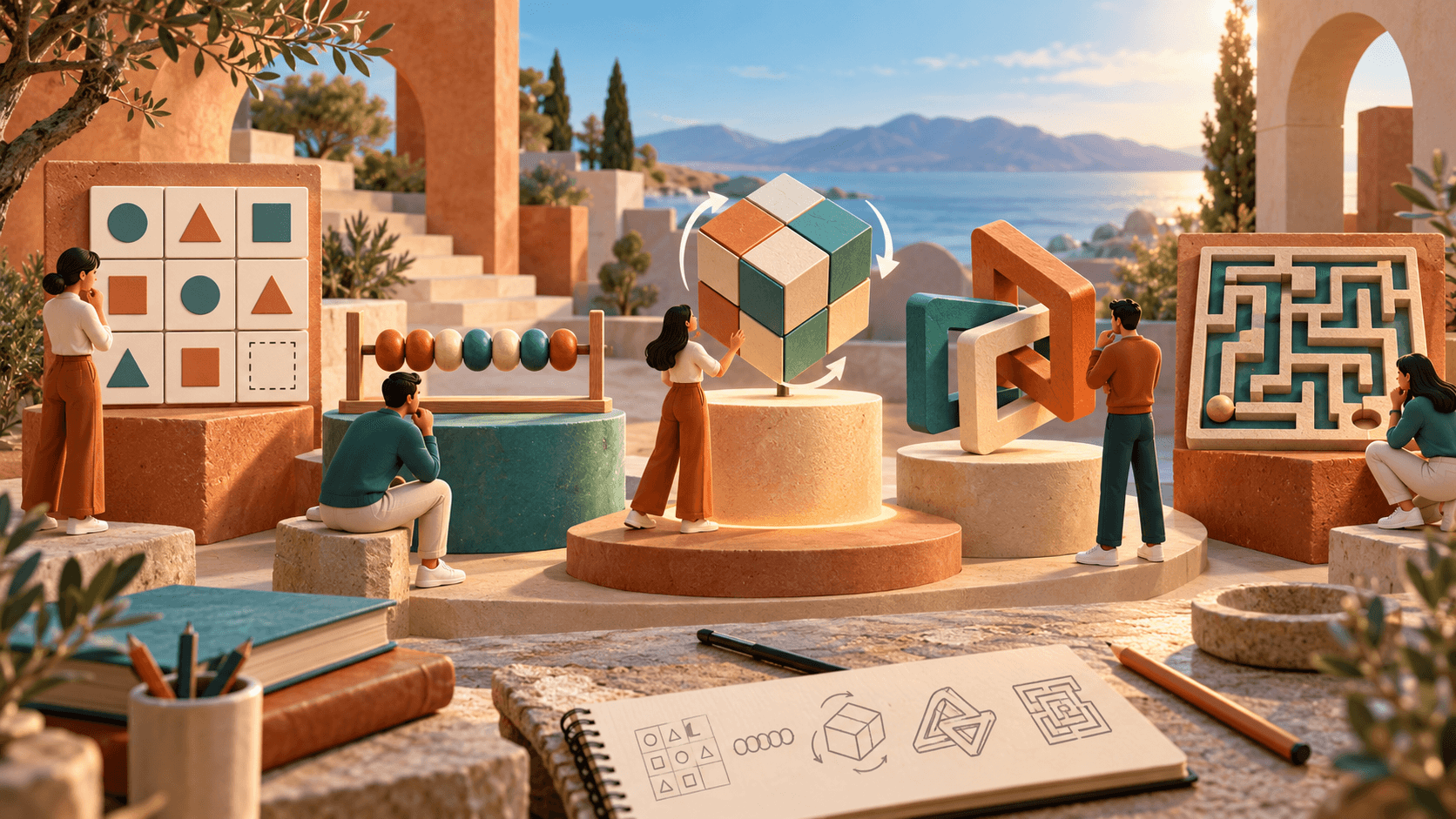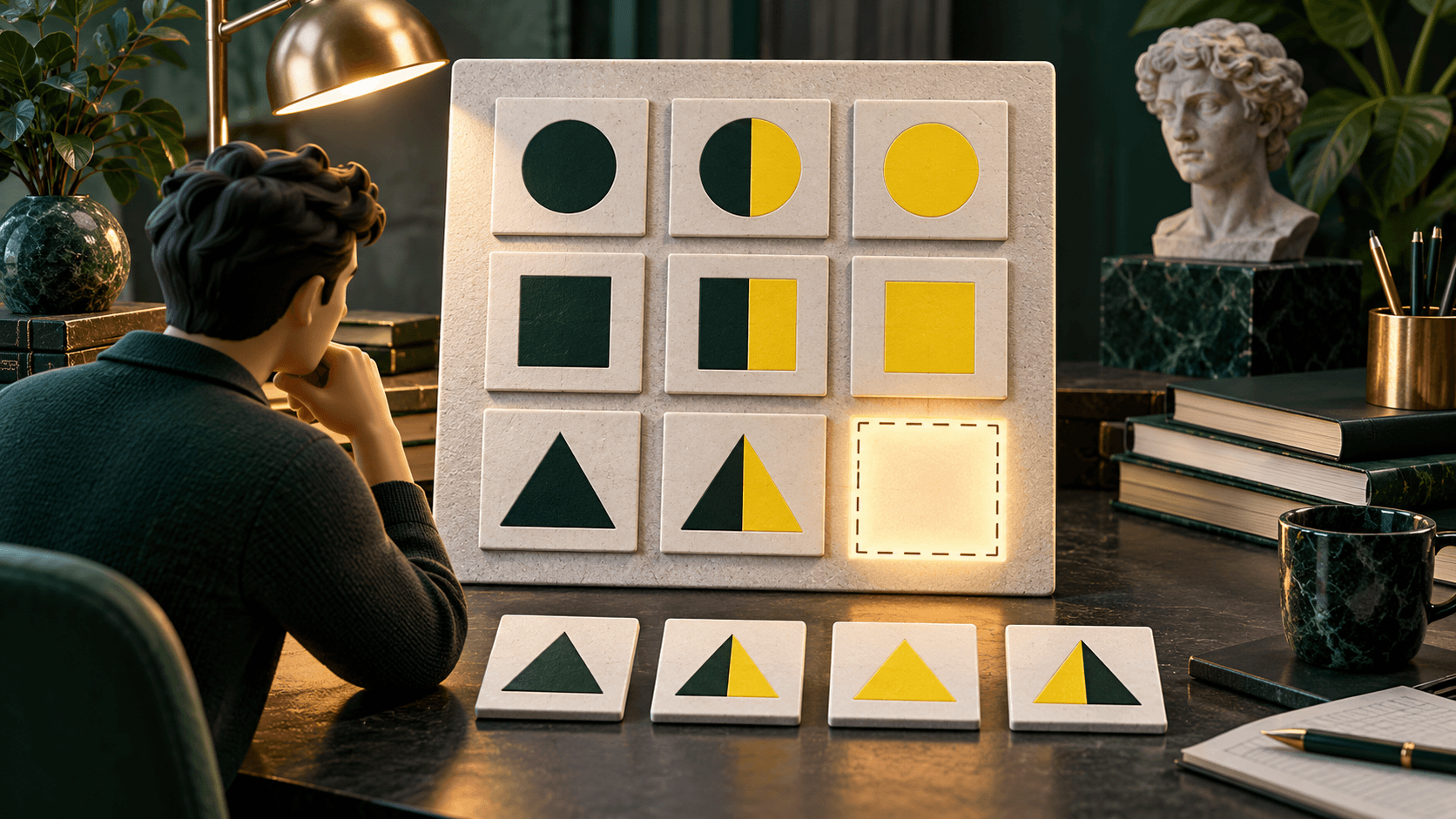
You look at a grid of eight shapes and one blank square. There are no words, no numbers and no instructions beyond "pick the piece that fits." Within a few seconds you notice the dots are multiplying along each row, and you feel a tiny click of satisfaction. That click is the whole point of one of the most influential tests in psychology.
If you have taken almost any IQ test, online or in person, you have met a descendant of Raven's Progressive Matrices. Here is where the test came from, the hidden rules that make each puzzle work, what it actually measures and what it cannot tell you.
What are Raven's Progressive Matrices?
Raven's Progressive Matrices are a set of nonverbal reasoning puzzles. Each item shows a pattern, usually a grid of figures with one piece missing, and you choose the missing piece from several options. The items get harder as you go, which is where "progressive" comes from.
The test was developed by the British psychologist John C. Raven, building on work with the geneticist Lionel Penrose, and first published in 1938. Raven wanted a way to measure reasoning that leaned as little as possible on reading, vocabulary or school knowledge. Matrices were his answer: you only need to look, compare and infer.
Today there are three main versions:
| Version | Designed for | What it looks like |
|---|---|---|
| Standard Progressive Matrices | General adult and teen population | 60 items in five sets, A to E, each set getting harder |
| Coloured Progressive Matrices | Young children and some older adults | Shorter, with coloured backgrounds to keep attention |
| Advanced Progressive Matrices | People expected to score highly | Fewer, much harder items to spread out the top end |
Why matrix puzzles show up almost everywhere
The original Raven's test is still used, but its bigger legacy is the format. Matrix-style items now sit inside many of the best-known intelligence batteries. The Wechsler scales include a Matrix Reasoning subtest, and research tools such as the International Cognitive Ability Resource (ICAR) use matrix items too. Most online IQ tests, including ours, lean on them heavily.
There are a few good reasons for that popularity:
- They are quick to administer. No spoken instructions, just a choice.
- They travel well. Because they avoid language, the same items work across age groups and translations.
- They correlate strongly with general ability. Scores on matrix tests line up closely with overall IQ, which makes them an efficient snapshot of reasoning.
If you want to see how matrices sit alongside other puzzle types, our guide to the types of IQ puzzles walks through the main families.
The hidden rules inside each puzzle
Matrix items feel mysterious until you realise they are built from a small toolkit of rules. In a well-known 1990 analysis, Patricia Carpenter, Marcel Just and Peter Shell studied how people solve the Advanced Progressive Matrices and found that most items can be described with a handful of rule types:
- Constant in a row. Something stays the same across a row, such as the shape or its colour.
- Quantitative progression. Something increases or decreases step by step: more dots, a bigger square, a rotating line.
- Addition or subtraction. The third figure is what you get when you overlay or remove parts of the first two.
- Distribution of three values. Three different values (say, a circle, a triangle and a square) each appear once in every row and column, like a mini Sudoku.
- Distribution of two values. Some elements appear in two figures of a row and are absent from the third.
Easy items use one rule. Hard items stack several rules at once, applied to different parts of the figure. Carpenter and colleagues found that what separated stronger solvers was less about spotting any single rule and more about holding several partial rules in mind and managing them as goals. That links matrix performance closely to working memory, your mental workspace for juggling information.
What Raven's actually measures
Raven's is usually described as a test of fluid intelligence: the ability to reason through new problems without relying on stored knowledge. You are not being asked what you know. You are being asked to find structure in something you have never seen.
That makes it different from tests of crystallised intelligence, such as vocabulary or general knowledge, which reflect what you have learned over time. If the distinction is new to you, our explainer on fluid vs crystallised intelligence covers it in more depth.
Psychologists also value Raven's because it is strongly linked to the general factor of intelligence, often called g. People who do well on matrices tend to do well on many other mental tests, so a matrix test works as a reasonable short estimate of overall reasoning.
What it does not measure
A matrix score is a narrow slice. It says little about:
- Verbal skill, reading comprehension or how well you explain ideas.
- Creativity, judgement or practical problem-solving in messy real-world settings.
- Motivation, persistence or emotional skills.
Is it really "culture-fair"?
Raven's was once promoted as culture-free, and you will still see that claim online. Researchers today are more careful. Removing words does reduce the role of language and schooling, but it does not remove experience entirely.
Familiarity with abstract shapes, multiple-choice formats and timed testing all make a difference. Years of diagrams and worksheets are, in effect, practice for the habits matrix puzzles reward. A fairer description is "less culturally loaded than many tests" rather than "culture-free."
Raven's and the Flynn effect
Raven's has a starring role in one of the strangest findings in intelligence research. When James Flynn gathered data on IQ scores over the 20th century, some of the largest gains he documented came from Raven's-style tests, including large rises among successive groups of military conscripts in the Netherlands.
Vocabulary and arithmetic scores rose far more slowly. Flynn argued that modern life increasingly trains people to think in abstract categories and hypotheticals, exactly the kind of reasoning matrices tap. You can read the full story in our post on the Flynn effect.
How to approach matrix puzzles
You cannot cram for fluid reasoning, but you can avoid the common traps that make people underperform:
- Scan rows and columns separately. Look across first, then down. Rules often run in both directions.
- Break the figure into parts. Track the outer shape, the inner shape and any lines or dots as separate streams.
- Predict before you peek. Picture the answer before looking at the options, so near-miss distractors are less tempting.
- Do not get stuck. If an item is eating your time, make your best guess and move on. Later items may still be in reach.
Some improvement from familiarity is normal, which is worth keeping in mind if you retake similar tests. When you feel ready, you can take our free IQ test and see how your pattern reasoning compares with other people your age.
The bottom line
Raven's Progressive Matrices turned a simple idea, find the missing piece, into one of the most widely used measures of reasoning ever made. Its format now lives inside most IQ tests because it is quick, largely language-free and closely tied to general ability. It is a sharp tool for measuring one important kind of thinking, but it was never meant to capture everything you are capable of.
FAQ
Is Raven's Progressive Matrices an IQ test?
Yes, it is a widely used test of nonverbal reasoning, and its scores can be converted into IQ-style scores. It is narrower than a full battery like the WAIS, which samples many different abilities.
Can you practise Raven's matrices to get a higher score?
Practice can raise scores a little by making the format familiar and teaching common rules. It does not appear to change your underlying reasoning ability much, so retest scores should be read with that in mind.
How long does Raven's test take?
It depends on the version and whether it is timed. The Standard version is often given in under an hour, while shorter matrix sections inside other tests may take only 10 to 20 minutes.