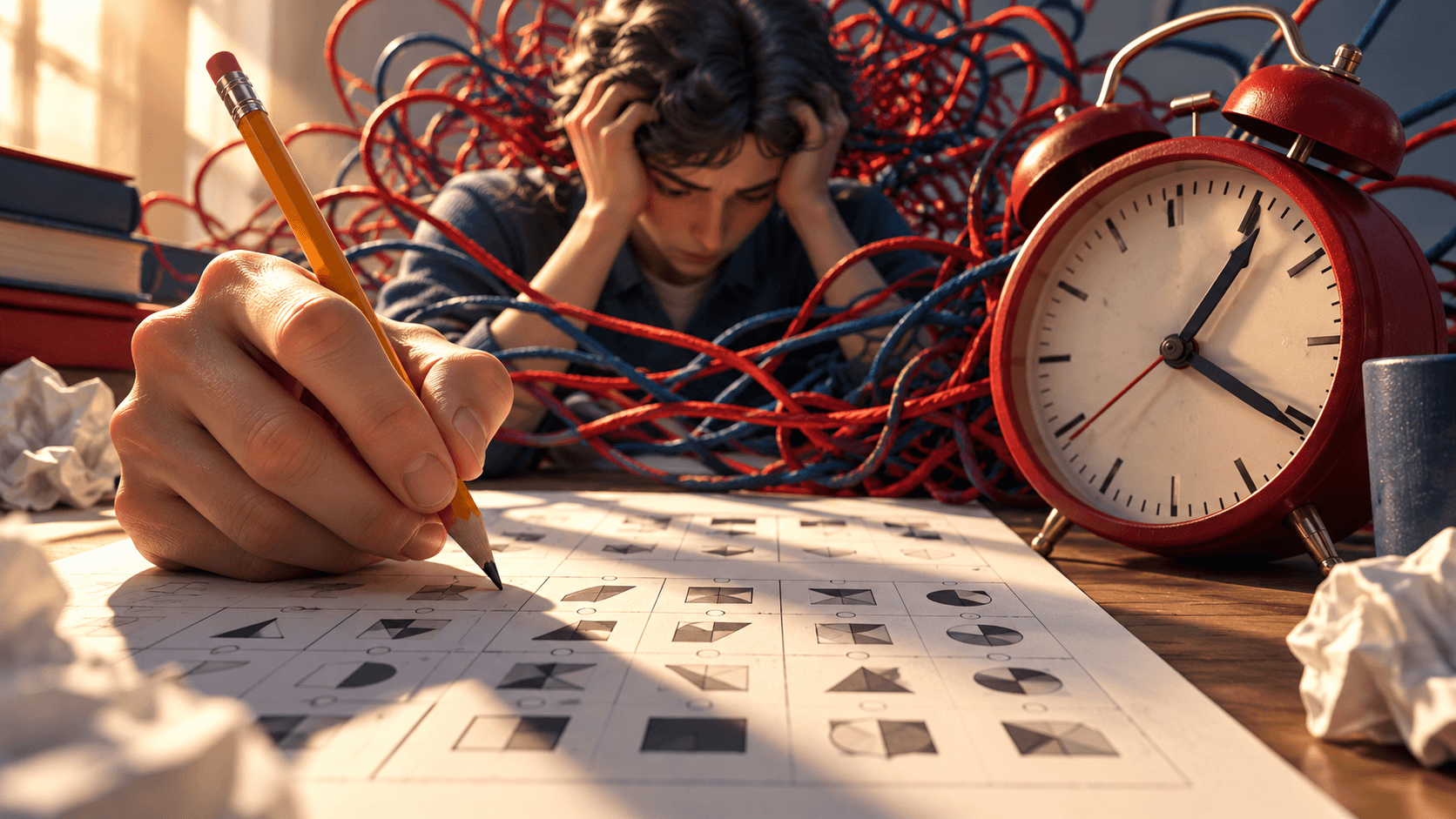
You lie awake until 3am, sleep badly until the alarm, and spend the next day rereading the same email three times. You feel slower, but is it real, or just tiredness talking?
It is real, though perhaps not in the way you expect. One rough night does not make you less intelligent. It does make some mental skills noticeably wobblier than others, and it makes you worse at judging your own performance. Here is what the research shows, and how to get through the day.
What happens in your brain after one bad night
Sleep is not just switching off. Overnight your brain consolidates memories and resets the systems that keep you alert. Cut that short and the effects show up the next day in a fairly consistent pattern.
Sleep researchers usually separate two situations: total sleep deprivation, where you stay awake all night, and partial sleep restriction, where you get some sleep but not enough. Most of us experience the second far more often, so it is the one that matters most in everyday life.
Attention takes the biggest hit
If you only remember one finding, make it this one. The mental skill most affected by sleep loss is sustained attention, the ability to stay focused on a simple task without drifting.
A 2010 meta-analysis by June Lim and David Dinges compared how different kinds of thinking held up after sleep deprivation. Simple attention and vigilance tasks were hit hardest. Complex reasoning was affected too, but noticeably less.
What this feels like in practice:
- Micro-lapses. Your mind briefly blanks for a second or two, often without you noticing.
- Slower reactions. Responses become more variable, with occasional long delays.
- More careless errors. You misread figures, skip a line or send the email to the wrong person.
This is why tiredness is so dangerous on the road. Research by Drew Dawson and Kathryn Reid found that after around 17 hours awake, performance on a coordination task dropped to a level similar to that of someone at a blood alcohol level that is illegal for driving in many countries.
Memory and learning
Sleep matters both before and after you learn something.
Before learning
A sleep-deprived brain is worse at taking in new information. Studies using brain imaging have found reduced activity in the hippocampus, a region central to forming new memories, after a night without sleep, along with poorer recall of material learned the next day.
After learning
Sleep also helps lock in what you learned the previous day. That is one reason pulling an all-nighter before an exam is a poor trade: you gain a few hours of study but lose some of the consolidation that would have helped you remember it.
Does it lower your IQ?
Not in any lasting way. Your underlying reasoning ability is the same after a bad night as it was the day before. What changes is your performance on the day.
Because IQ tests rely on concentration, working memory and processing speed, a tired brain can underperform. You might misread a question, lose your place in a multi-step puzzle or run short of time. The scores most likely to slip are on timed tasks and tasks that require you to hold several pieces of information in mind at once.
| Mental skill | Effect of one poor night | Why |
|---|---|---|
| Sustained attention | Large | Frequent micro-lapses and slower reactions |
| Learning new information | Moderate to large | Memory encoding is less efficient |
| Working memory | Moderate | Harder to hold and update information |
| Processing speed | Moderate | Responses become slower and less consistent |
| Complex reasoning | Smaller | Often holds up, especially on engaging problems |
| Mood and emotional control | Moderate to large | More irritable and reactive to setbacks |
| Judging your own performance | Poor | You tend to underestimate how impaired you are |
So if you are planning to measure yourself, it is worth doing it rested. Our article on test anxiety and IQ covers other temporary factors that can drag a score down.
Mood, judgement and risk
Sleep loss does not only affect cold cognition. It changes how you feel and how you make choices.
Brain imaging studies have found that the amygdala, which helps process emotional reactions, responds more strongly to negative images after sleep deprivation, while its connection to the more reflective prefrontal regions weakens. In plain terms, small annoyances feel bigger and it is harder to talk yourself down.
People who are short on sleep also tend to:
- Find it harder to switch strategies when something is not working.
- Make riskier or more impulsive decisions.
- Read neutral faces and messages as more hostile.
None of this is a character flaw, and it usually lifts once you have slept.
The trap of not noticing
Perhaps the most surprising finding comes from a 2003 study by Hans Van Dongen and colleagues. Volunteers who were restricted to six hours of sleep a night for two weeks built up deficits in attention similar to those seen after one or two nights of no sleep at all.
The twist was that they did not feel that bad. Their sense of sleepiness levelled off after a few days, while their actual performance kept getting worse. In other words, "I'm used to it" is often not true. You may simply have stopped noticing.
How to get through the day after a bad night
You cannot fully undo a poor night, but you can work with it.
- Do demanding work early. Many people have a window of reasonable alertness in the morning before the afternoon dip.
- Get daylight and move. A short walk outside can lift alertness and mood. We look at the evidence in exercise and the brain.
- Use caffeine sensibly. Coffee helps with alertness, but it masks rather than replaces sleep, and late cups can sabotage the next night. More on that in does coffee make you smarter?.
- Double-check anything important. Build in a second look for emails, figures and decisions.
- Try a short nap. Around 20 minutes in the early afternoon can restore some alertness without leaving you groggy.
How fast do you recover?
The good news: after a single bad night, one or two nights of decent sleep usually restore most of your performance. Recovering from weeks of short sleep tends to take longer.
If you want a fair picture of your reasoning ability, choose a day when you are well rested and take our IQ test then, rather than after a night of tossing and turning.
If poor sleep has become a regular pattern, or you often wake unrefreshed despite enough time in bed, it is worth mentioning to your GP or a healthcare professional.
The bottom line
One bad night does not make you less intelligent, but it does make your brain work less reliably. Attention, memory and mood suffer most, reasoning holds up better, and you are likely to underestimate the damage. Plan around it, go easy on yourself, and let a good night's sleep do the repair work.
FAQ
Can one night of bad sleep affect an IQ test score?
It can lower your performance on the day, especially on timed tasks and puzzles that rely on working memory. Your underlying ability does not change, so a rested retest gives a fairer result.
How many hours of sleep do adults need to think clearly?
Most adults function best with around seven to nine hours a night. Individual needs vary, but regularly getting much less than seven is linked to poorer attention and memory.
Does catching up on sleep at the weekend fix the damage?
It helps, particularly after a short run of poor nights. But research suggests that recovering from long stretches of short sleep can take more than one lie-in.
Why do I feel fine but still make mistakes when tired?
Your sense of sleepiness tends to level off after a few short nights while your performance keeps slipping. That gap is why tired people often underestimate how impaired they are.