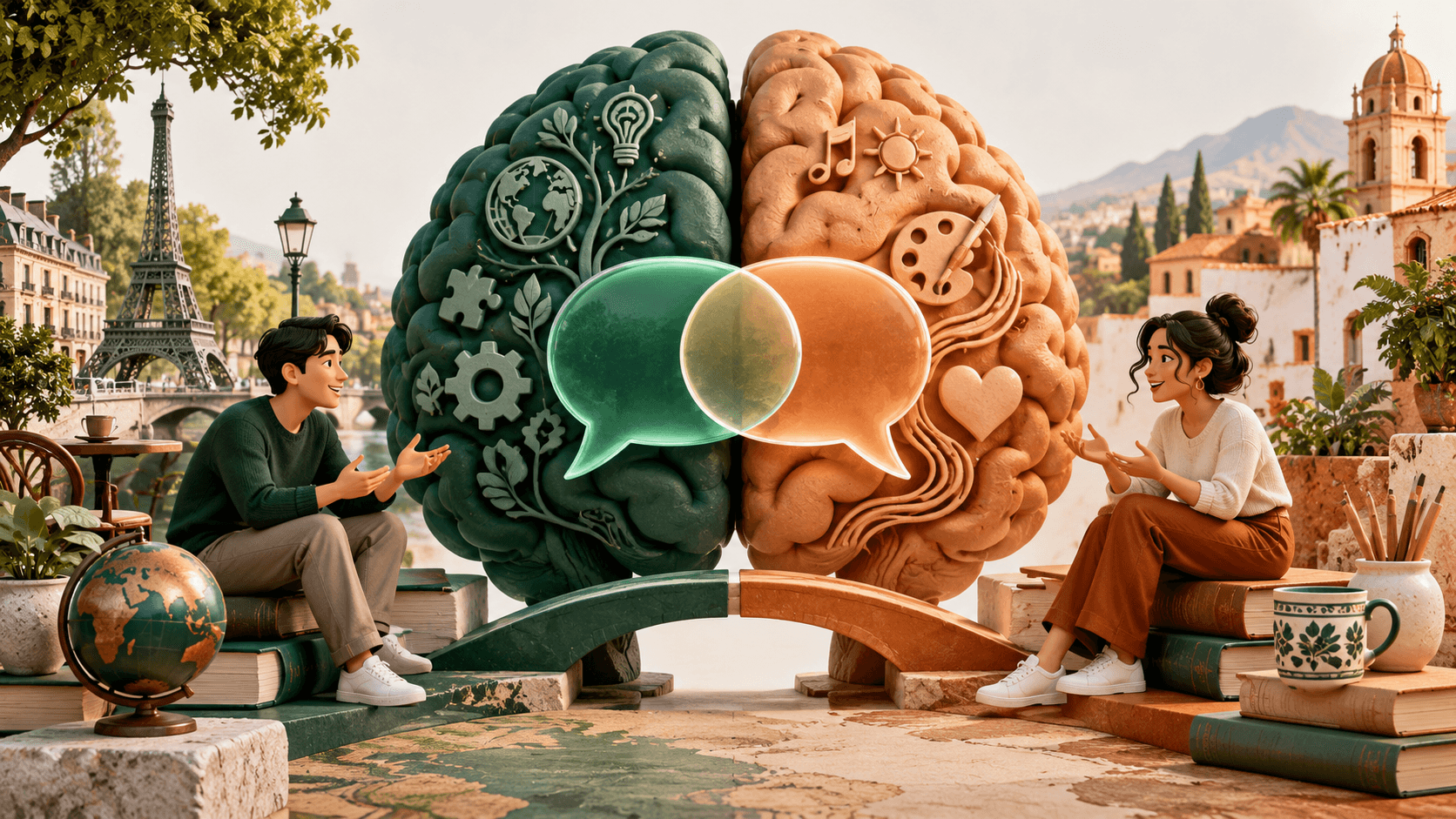
For much of the early twentieth century, many educators believed that raising a child with two languages would confuse them and hold back their intelligence. Parents were sometimes told to drop the "home" language altogether.
A few decades later, the story flipped completely. Bilingual people, the new headlines said, have sharper minds, better focus and brains that age more slowly. Today the evidence points somewhere more surprising: neither story holds up as well as it sounded. Here's what research actually shows, and what learning a second language genuinely gives you.
The old fear: bilingualism as a handicap
Early studies did seem to find that bilingual children scored lower on intelligence tests. Looking back, those studies had serious problems:
- Children were often tested in a language they were still learning.
- Researchers rarely accounted for differences in family income, schooling or circumstances.
- Vocabulary in each single language was treated as a measure of overall ability.
A turning point came in 1962, when Elizabeth Peal and Wallace Lambert studied children in Montreal and carefully matched bilingual and monolingual groups on background. Rather than lagging behind, the bilingual children did as well or better on many measures. The "bilingual handicap" faded from serious research.
The rise of the "bilingual advantage"
From the 1990s onwards, psychologist Ellen Bialystok and others developed a bold new idea. If you speak two languages, both are active in your mind to some degree, and you constantly have to select one and suppress the other. Perhaps that daily juggling trains the brain's general control systems.
Those systems are known as executive functions, and they include:
- Inhibitory control: ignoring distractions and resisting the wrong response.
- Task switching: shifting smoothly between rules or activities.
- Working memory: holding and updating information in mind.
Early studies, often using quick computer tasks where people have to ignore misleading cues, found that bilinguals responded a little faster or more accurately. The idea spread quickly through books, articles and parenting advice.
Then the evidence got complicated
As more researchers tested the idea, results became inconsistent. Several large studies, including work by Kenneth Paap and Zachary Greenberg in 2013, found no reliable bilingual advantage across a range of executive function tasks.
Two other findings shaped the debate:
Publication bias
In 2015, Angela de Bruin, Barbara Treccani and Sergio Della Sala looked at conference abstracts on the topic and checked which ones went on to be published in journals. Studies supporting a bilingual advantage were considerably more likely to be published than studies that found none. That means the published literature may have made the effect look stronger than it is.
Meta-analyses
A 2018 meta-analysis led by Minna Lehtonen pooled over a hundred studies of adults. It found small apparent advantages on some measures, but once the analysis corrected for publication bias, there was little evidence of a genuine bilingual advantage in executive functions.
Not every researcher agrees. Some argue that the effect depends on how bilingual you are, how often you switch languages and which tasks are used. But the confident claim that bilingualism makes you sharper is no longer the consensus.
So, does it raise IQ?
Not in any way research can reliably detect. Here's a summary of where the main claims stand:
| Claim | What the evidence suggests |
|---|---|
| Bilingualism harms intelligence | Not supported. Early studies were badly confounded |
| Bilingualism raises IQ | No good evidence of a general IQ boost |
| Bilinguals have better executive control | Mixed. Recent large studies and bias-corrected reviews find little or no advantage |
| Bilingualism delays dementia symptoms | Mixed. Some striking findings, but results vary by study design |
| Bilingualism brings real practical and social benefits | Yes, clearly |
The honest summary is that bilingualism doesn't seem to make you smarter, but it doesn't make you less smart either. That alone is a big change from the advice parents were once given.
What about ageing and dementia?
This is where the most hopeful claims come from. In 2007, Ellen Bialystok, Fergus Craik and Morris Freedman reported that among patients attending a memory clinic, bilinguals tended to show dementia symptoms around four years later than monolinguals.
The idea behind it is cognitive reserve: a lifetime of mentally demanding activity might help the brain cope with damage for longer before symptoms appear. It's a reasonable idea, and similar effects have been linked to education and complex work.
However, later studies have been mixed. Some of the strongest results came from clinic records, where it's hard to rule out other differences between groups, such as education or life history. Studies that follow people forward in time often find smaller effects or none. It's an open question, not a settled fact.
What bilingualism reliably gives you
Set the IQ question aside and the case for speaking two languages is strong on its own terms:
- More people to talk to. Friendships, work and travel open up in ways no test score can capture.
- Access to culture. Books, films, humour and ideas in their original form.
- Family connection. For many people, a heritage language is a link to grandparents and history.
- Language awareness. Bilingual children often show a good early understanding of how language works, such as knowing that words are arbitrary labels.
- Career options. Many roles value or require a second language.
For adults, learning a language is also a long, effortful mental challenge, the kind of sustained learning that our guide to whether you can increase your IQ highlights as worthwhile for thinking in general. Just don't expect a measurable jump in your score.
So if you want to learn a language, go for it: to read, travel, connect and enjoy the challenge. And if you'd like a snapshot of your reasoning skills as you go, try our free IQ test. Treat the score as a baseline rather than something a new language will dramatically change.
Why the "smarter" story is so sticky
The bilingual advantage was an appealing idea. It was positive, it had a clear mechanism and it reassured families who had been told the opposite for decades. Ideas like that spread quickly and are slow to be revised, which is the same pattern seen with brain training apps.
There's also a measurement challenge. "Bilingual" covers everyone from a child raised in two languages from birth to an adult with good school French. Lumping such different experiences together makes clean answers hard to find.
The bottom line
The belief that bilingualism harms intelligence was wrong, and the newer belief that it boosts intelligence looks overstated. Large studies and bias-corrected reviews find little evidence of a general cognitive advantage, and the dementia findings remain debated. What speaking two languages does offer is richer communication, culture and connection, which is a better reason to learn one anyway.
FAQ
Are bilingual people smarter?
Research doesn't show that bilingual people are more intelligent on average. Claims of better executive control have been hard to replicate in large, careful studies.
Does raising a child bilingual cause language delays?
Bilingual children may know fewer words in each individual language at first, but research does not support the idea that bilingualism harms long-term language development or intelligence.
Does learning a language as an adult make you smarter?
It won't reliably raise your IQ, but it's a demanding and rewarding form of learning that keeps your mind engaged and brings many practical benefits.