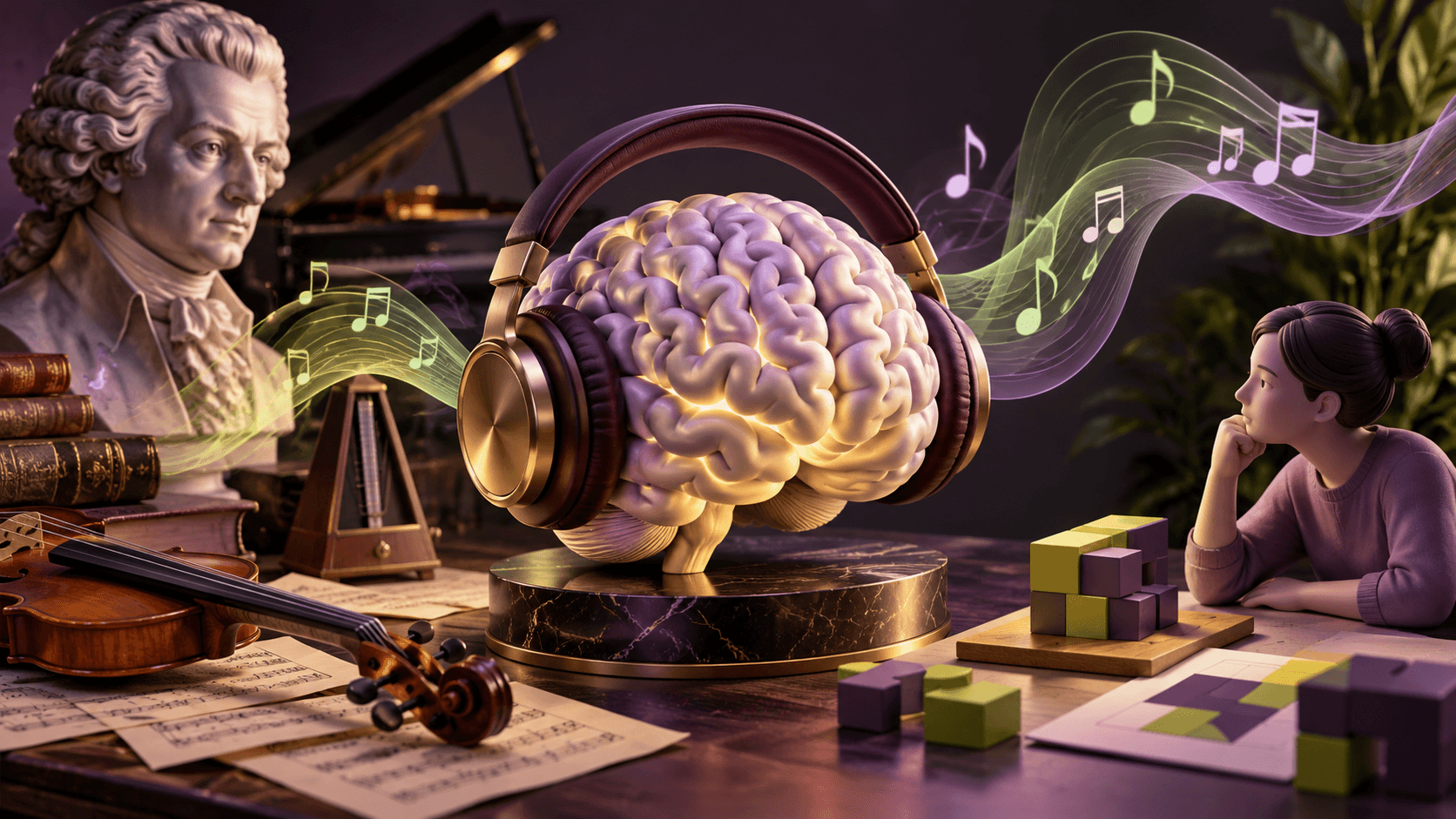
In the late 1990s, a US state governor proposed giving every newborn a classical music CD. The idea was simple and irresistible: play babies Mozart and they'll grow up smarter. Shops filled with "brain-boosting" baby albums, and the phrase "the Mozart effect" entered everyday language.
The research behind it was real, but it said something much smaller than the headlines. And the bigger question parents actually care about, whether learning an instrument makes a child cleverer, has a more interesting answer. Here's what the evidence shows.
Where the Mozart effect came from
In 1993, psychologists Frances Rauscher, Gordon Shaw and Katherine Ky published a short paper in Nature. College students who listened to about ten minutes of a Mozart sonata did slightly better on a spatial reasoning task than when they had sat in silence or listened to relaxation instructions.
Three details tend to get lost:
- The participants were adults, not babies.
- The improvement was on spatial tasks, like imagining how a folded and cut piece of paper would look, not on general intelligence.
- The effect was brief, fading within roughly a quarter of an hour.
Nobody in the original study claimed that Mozart makes you smarter in any lasting way. That leap happened in the press.
Did the Mozart effect hold up?
Mostly no. Many labs tried to replicate it, with mixed results. A meta-analysis by Christopher Chabris in 1999 concluded that any effect was small, and a larger meta-analysis by Jakob Pietschnig and colleagues in 2010 reached a similar verdict: little evidence of a specific Mozart effect on spatial ability.
The most convincing explanation came from Glenn Schellenberg and colleagues. Their work suggested that what matters is arousal and mood. Music you enjoy can leave you a bit more alert and positive, and people who feel alert and positive tend to do slightly better on many tasks. In one study, a fast, cheerful Mozart piece helped while a slow, sad piece by Albinoni did not, and the difference disappeared once mood and arousal were taken into account. In another, British schoolchildren did better on a task after hearing pop music they liked than after hearing Mozart.
In other words, there is nothing magical about Mozart. A good mood helps you think for a few minutes. So would a coffee you enjoy or a funny video.
Listening versus learning: two very different questions
It helps to separate two claims that often get blurred:
| Claim | What the evidence suggests |
|---|---|
| Listening to classical music raises IQ | Not supported. Any boost is small, short-lived and linked to mood |
| Playing music for babies makes them smarter | No good evidence |
| Music lessons are linked to higher IQ | Yes, there is a reliable correlation |
| Music lessons cause higher IQ | Uncertain. Effects in experiments are small at best and often disappear |
The first two are essentially myths. The last two need a closer look.
The correlation: musicians do tend to score higher
Children who take music lessons, and adults who had them, tend to score a little higher on IQ tests and do better at school on average. This finding is fairly consistent.
The hard part is working out why. Several things travel together with music lessons:
- Family income and education. Lessons cost money and time, and families who can provide them also tend to provide other advantages.
- Personality. Research by Kathleen Corrigall, Glenn Schellenberg and colleagues found that children who take music lessons tend to score higher on conscientiousness and openness to experience, traits that also help with school and testing.
- Pre-existing ability. Children who find learning easier may be more likely to start lessons and much more likely to stick with them for years.
So the correlation could largely reflect who takes music lessons rather than what music lessons do.
What happens in actual experiments
To test cause and effect, you need to randomly assign children to music lessons or not, then compare them later.
Schellenberg's 2004 study
One of the best-known experiments assigned six-year-olds to a year of keyboard lessons, voice lessons, drama lessons or no lessons. The music groups gained slightly more in IQ than the others, by a few points. It was a genuine but modest difference, and it came from a single study.
Later trials and reviews
Larger and more careful work has been less encouraging. Two randomised trials led by Samuel Mehr in 2013 found no clear cognitive advantage for preschoolers given music classes. Meta-analyses by Giovanni Sala and Fernand Gobet have argued that the better designed a study is, especially when the comparison group does another engaging activity, the smaller any benefit becomes, often shrinking towards zero.
The current picture, then: music training probably doesn't produce meaningful gains in general intelligence. This fits a wider pattern seen with brain training apps. People get better at what they practise, but the gains rarely spread to unrelated abilities.
What learning an instrument genuinely does
None of this means music lessons are a waste. The benefits just aren't the ones the Mozart effect promised. Learning an instrument reliably builds:
- Musical skill itself, which is a worthwhile thing to have.
- Fine motor control and coordination, through hours of precise practice.
- Listening skills, such as hearing pitch and rhythm more precisely.
- Habits of practice, including patience and working towards long-term goals.
- Enjoyment and connection, from playing with others and having a lifelong hobby.
These are good reasons to learn. "Adding IQ points" just isn't one of them, at least on current evidence. If you're curious about the habits that do have stronger support, such as education and sleep, see our guide to whether you can increase your IQ.
So should you learn an instrument?
If you want to, absolutely. Learning something hard as an adult keeps your mind engaged, and music is one of the most rewarding hard things there is. Just choose it for the music, not for the score.
And if you'd like to know where your reasoning skills stand right now, try our free IQ test. It measures pattern-based reasoning, the kind of thinking the Mozart studies hoped to boost, and it makes a useful baseline whatever you decide to learn next. For more popular ideas that didn't survive scrutiny, see our list of famous IQ myths.
The bottom line
The Mozart effect began as a brief, small improvement on a spatial task in adults, and it was largely explained by mood. Children who learn instruments do tend to score higher on IQ tests, but that seems to reflect who takes lessons more than what lessons do. Learn music for its own rewards, which are real and plentiful.
FAQ
Is the Mozart effect real?
Only in a very limited sense. Listening to music you enjoy can briefly improve performance on some tasks by lifting mood and alertness, but there is no lasting effect on intelligence.
Do music lessons make children smarter?
Children who take lessons tend to score higher on IQ tests, but experiments suggest lessons themselves have a small effect at most. Family background and personality explain much of the link.
Is it too late to learn an instrument as an adult?
No. Adults can learn instruments at any age, and the practice, enjoyment and challenge are worthwhile in their own right.
Does listening to music while studying help?
It depends on the person and task. Music you like may lift your mood, but music with lyrics can distract from reading and writing, so many people focus better with instrumental music or silence.