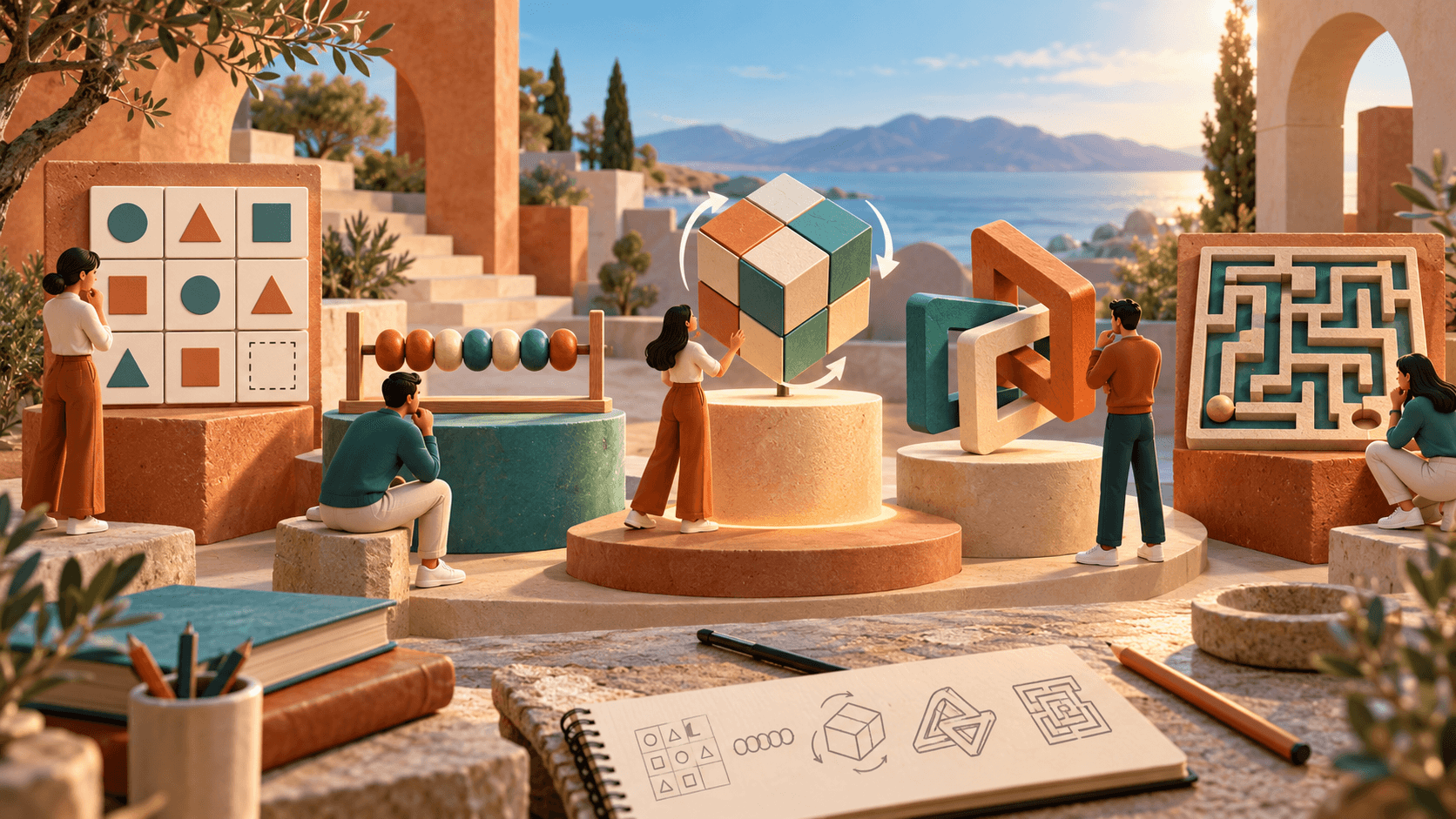
You glance at a row of shapes: circle, square, triangle, circle, square. Before you have finished reading, your brain has already filled in the next one. That tiny flash of "oh, it's a triangle" is pattern recognition, and it happens to you hundreds of times a day without you noticing.
It is also the skill IQ test designers lean on more than almost any other. Matrices, number series, odd-one-out puzzles and analogies are all, at heart, pattern problems. Here is what the skill actually involves, why tests treat it as such a good window into reasoning, and what you can and cannot do to improve it.
What pattern recognition actually is
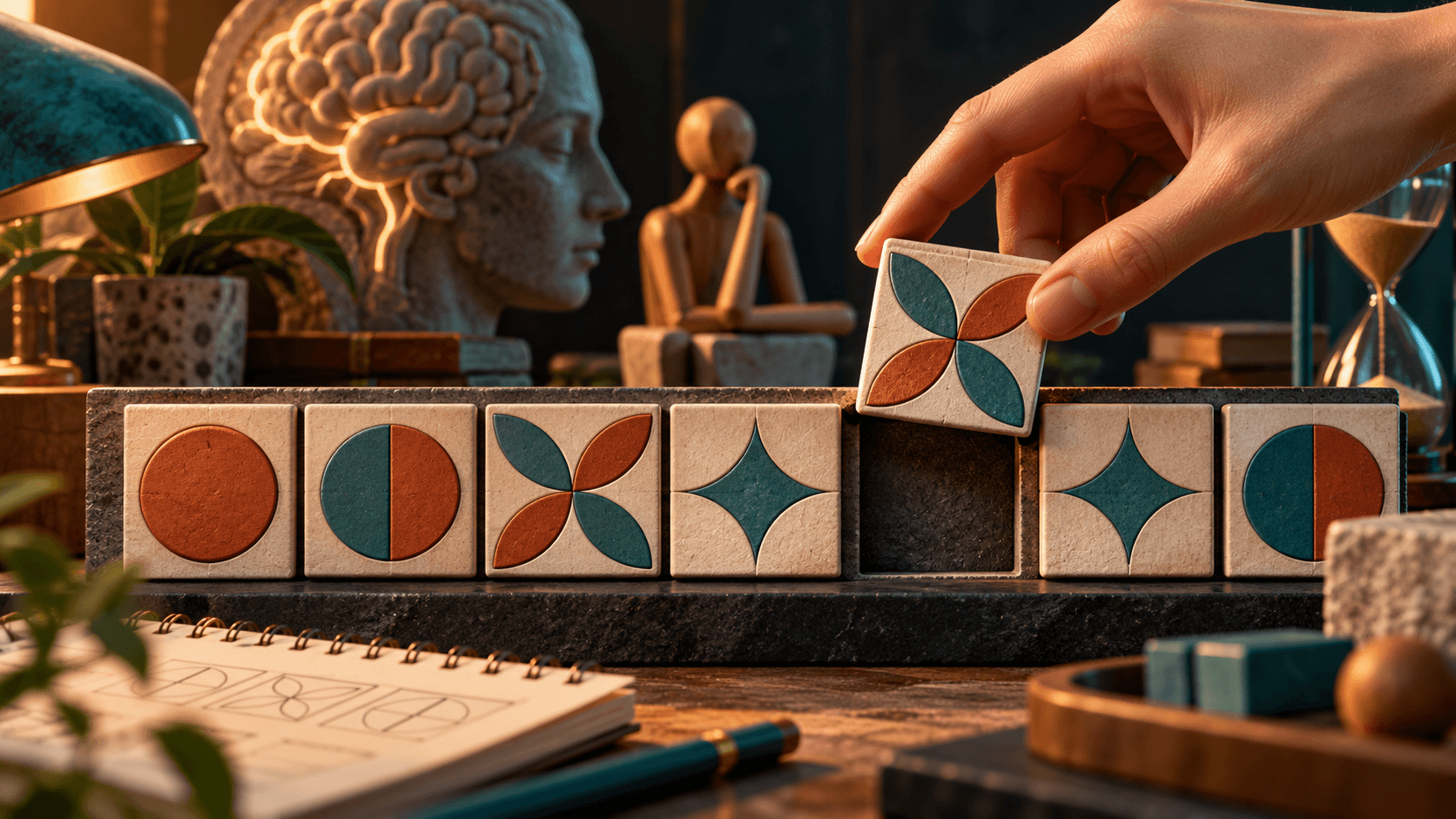
Pattern recognition means noticing regularities: things that repeat, change predictably or belong together. It breaks into a few quick steps:
- Perceiving the elements. You register the shapes, numbers or words in front of you.
- Comparing them. You notice what stays the same and what changes.
- Inferring a rule. You form a guess about why it changes, such as "each step adds one side."
- Testing the rule. You check whether the guess holds across every example.
- Applying it. You use the rule to predict the missing piece.
The early psychologist Charles Spearman described the core of intelligence in similar terms: the ability to work out relationships between things and then apply those relationships to something new. Pattern recognition is that idea in its purest, most testable form.
Why IQ tests love pattern puzzles
There are good reasons test designers keep coming back to pattern problems.
They measure reasoning, not knowledge
A matrix puzzle made of abstract shapes does not require you to know any history, vocabulary or maths formulas. That makes it a fairly direct measure of fluid intelligence, your ability to reason with information you have never seen before. It strips away knowledge and leaves the reasoning.
They line up closely with general ability
People who do well on pattern puzzles tend to do well on many other kinds of mental tasks too. In the language of intelligence research, matrix-style problems load strongly on the general factor, often called g. That makes them efficient: a relatively short set of puzzles gives a reasonable estimate of broader reasoning ability.
They scale smoothly in difficulty
Adding or combining rules makes a puzzle harder, so one format can challenge both a ten-year-old and a professor.
The best-known example is Raven's Progressive Matrices, first published by John C. Raven in 1938 and still used today. We look at its history and design in our piece on Raven's Progressive Matrices.
The main types of pattern puzzle
Most pattern questions on IQ tests fall into a handful of families. Each one stresses a slightly different part of the skill.
| Puzzle type | What you see | What it mostly tests |
|---|---|---|
| Matrices | A grid of shapes with one cell missing | Spotting rules across rows and columns |
| Number series | A sequence like 2, 6, 12, 20, ? | Finding numerical relationships |
| Odd one out | Several items, one of which does not fit | Grouping by shared features |
| Analogies | A is to B as C is to ? | Transferring a relationship to a new case |
| Spatial rotation | A shape shown from different angles | Mentally manipulating objects |
The number series above, by the way, goes 2, 6, 12, 20, 30: the gaps grow by two each time. For tips on cracking each family, see our guide to the main types of IQ puzzle.
What makes a pattern puzzle hard
Researchers who have studied matrix tests closely, such as Patricia Carpenter, Marcel Just and Peter Shell in their 1990 analysis of Raven's, found that the hardest items are not hard because the individual rules are exotic. They are hard because:
- There are more rules to track at once. Holding three changing features in mind is far tougher than holding one.
- The rules interact. A shape might rotate and change colour and lose a line, all at the same time.
- The obvious rule is a decoy. The first pattern you notice may only explain part of the grid.
That is why pattern recognition is tightly linked to working memory. Spotting a rule is one thing; keeping several rules in your head while you check them against each other is another. Our piece on working memory explains why this mental workspace matters so much.
Pattern recognition outside the test room
The skill is not just a quirk of puzzles. Versions of it show up everywhere:
- A doctor noticing that a cluster of symptoms fits a familiar picture.
- A chess player seeing that a position "looks like" one they have studied.
- A mechanic hearing a particular rattle and knowing roughly where to look.
- A parent sensing that a child's mood follows a predictable daily rhythm.
Classic studies of chess players, starting with Adriaan de Groot and later William Chase and Herbert Simon, showed that experts remember realistic board positions far better than novices, but lose much of that advantage when the pieces are placed randomly. Their edge comes from a huge library of familiar patterns, not a better memory overall.
So pattern recognition has two sides: general reasoning, which IQ tests try to capture, and learned expert intuition, built through years of practice in one field.
The downside: seeing patterns that are not there
A brain tuned to find patterns will sometimes find them in noise. Seeing faces in clouds, believing a "lucky" shirt changes results, or reading meaning into a run of coincidences are all examples. Psychologists sometimes call this tendency apophenia.
It is a side effect of a system built for fast predictions, not a sign of poor intelligence. The fix is the fourth step from earlier: test the rule against every example, not just the ones you noticed.
Can you get better at it?
The honest answer has two parts.
You can get better at the puzzles. Once you know matrices often involve rotation, counting or adding and removing elements, you spend less time confused. Practice effects are real but usually modest.
Raising your underlying reasoning is harder. Evidence that puzzle practice transfers to broad intelligence is weak. What helps most is looking after the basics your brain relies on: good sleep, regular movement and staying mentally engaged with genuinely new challenges.
A few practical habits make a difference on the day:
- Describe each change in words: "it rotates a quarter turn each step."
- Check rows and columns separately, then together.
- Count elements. Many rules are simply about adding or removing items.
- If you are stuck, eliminate answer options that break any rule you are sure of.
If you want to see how your pattern reasoning compares, you can try our free IQ test, which uses matrix-style items built on the same principles described here.
The bottom line
Pattern recognition is the ability to notice regularities, infer the rule behind them and apply it to something new. IQ tests love it because it measures reasoning without leaning on knowledge, tracks general ability closely and scales neatly in difficulty. You can get more comfortable with the puzzles through practice, but the deeper skill is best supported by a healthy, curious, well-rested brain.
FAQ
Is pattern recognition the same as intelligence?
Not exactly. It is one of the clearest single indicators of general reasoning ability, but intelligence also includes knowledge, verbal skill, memory and processing speed.
Why do IQ tests use shapes instead of words?
Abstract shapes reduce the influence of language and education, so the test focuses more on reasoning itself. That makes results somewhat fairer across people with different backgrounds.
Can practising matrix puzzles raise my IQ?
Practice can raise your score on similar puzzles a little, mostly by making the format familiar. It does not reliably raise your broader reasoning ability.
Is seeing patterns everywhere a good sign?
It depends on whether the patterns hold up. Noticing real regularities is useful, but the sharpest thinkers also check their hunches against the evidence.