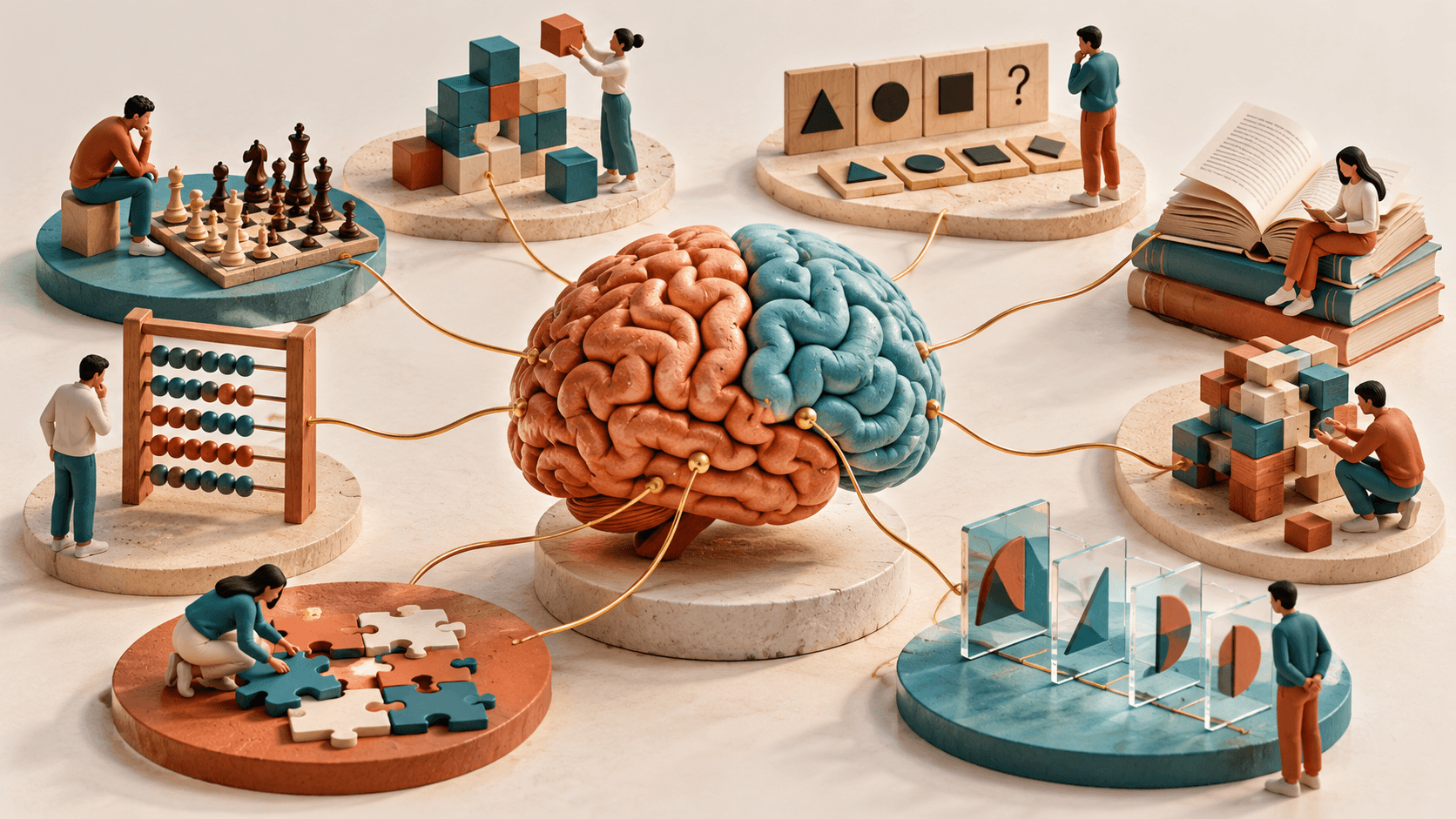
Here's an odd fact that has puzzled psychologists for more than a century: people who are good at vocabulary tests also tend to be good at mental arithmetic, memory tasks and spatial puzzles. These skills look completely different. Yet scores on all of them tend to rise and fall together.
That pattern gave rise to the g factor, the idea of a single general intelligence underlying all kinds of thinking. It's one of the most replicated findings in psychology and one of the most argued about. Here's what g is, why it matters, and why the debate still hasn't settled.
What is the g factor?
In 1904, the British psychologist Charles Spearman noticed that schoolchildren's marks in very different subjects were positively correlated. Children who did well in classics also tended to do well in maths, French and even simple sensory tasks. He proposed that a general factor, which he called g, contributed to performance on all of them, alongside specific abilities for each task.
Since then, the same pattern has turned up almost every time researchers give people a varied set of mental tests. Psychologists call it the positive manifold: scores on different cognitive tests are nearly always positively correlated. Using a statistical technique called factor analysis, researchers can extract the shared component, and that's g.
The key point is that g isn't measured directly. It's what's left when you look at what all the tests have in common.
How much does g explain?
In a typical battery of cognitive tests, g usually accounts for a large share of the differences between people, often estimated at around 40 to 50 per cent. The rest comes from broader abilities like verbal or spatial skill, narrower specific skills and measurement error.
Some tests are especially good at capturing g. Abstract reasoning puzzles, such as Raven's Progressive Matrices, tend to load heavily on it, which is why versions of them appear in so many IQ tests. A full-scale IQ score from a broad test is generally treated as a good practical estimate of g.
Why psychologists care about g
g is not just a statistical curiosity. It predicts a range of real outcomes:
- Education: g is one of the strongest predictors of school grades and years of education.
- Work: A widely cited review by Frank Schmidt and John Hunter found general mental ability to be among the best single predictors of job performance, especially in complex jobs.
- Learning: People higher in g tend to pick up new, complex information faster.
These are averages across many people, not destinies. Plenty of factors, from conscientiousness to opportunity and health, also shape how life turns out.
The big argument: is g real?
Almost nobody disputes the positive manifold itself. The argument is about what causes it.
One ability or many?
In the 1930s, Louis Thurstone challenged Spearman by identifying several "primary mental abilities," such as verbal comprehension, number and spatial skill. But when his primary abilities were tested, they correlated with each other too, which pointed back to a general factor above them. Much of the twentieth-century debate went this way: separate abilities exist, and they still share something.
A thing, or a summary?
Critics, including Stephen Jay Gould in The Mismeasure of Man, argued that treating g as a physical "thing" in the head is a mistake. A statistical factor, they said, is a summary of correlations, not proof of a single underlying cause. Many psychologists today accept g as a useful description while staying cautious about what exactly it reflects in the brain.
Mutualism: abilities that boost each other
In 2006, Han van der Maas and colleagues proposed the mutualism model. Instead of one general ability causing all the correlations, separate abilities could support each other as they develop. Better vocabulary helps reading, which helps reasoning, which helps learning more vocabulary. Over time, those mutual boosts would produce a positive manifold without any single g underneath.
Process overlap theory
Kristof Kovacs and Andrew Conway's process overlap theory offers another explanation. Different tests draw on overlapping sets of mental processes, especially executive processes like controlling attention. Because most tests tap some of the same processes, their scores correlate, and g emerges as a by-product of that overlap.
Each of these models can reproduce the positive manifold. That's why the argument keeps going: the data fit several stories.
Where g sits in modern theories
Most researchers today use a hierarchical model, often called the Cattell-Horn-Carroll (CHC) model, building on John Carroll's large 1993 reanalysis of factor-analytic studies.
| Level | What it includes | Example |
|---|---|---|
| Top (stratum III) | General intelligence, g | Overall IQ |
| Middle (stratum II) | Broad abilities | Fluid reasoning, crystallised knowledge, processing speed, visual processing, memory |
| Bottom (stratum I) | Narrow abilities | Vocabulary, mental rotation, digit span |
In this picture, g and specific abilities aren't rivals. They're different levels of the same structure. Our guide to fluid vs crystallised intelligence explains two of the most important broad abilities.
What about multiple intelligences?
Howard Gardner's theory of multiple intelligences proposes separate, independent intelligences such as musical, interpersonal and bodily-kinaesthetic. It's popular in education, but it struggles with the positive manifold: when the cognitive abilities it describes are measured, they tend to correlate rather than stand apart. We cover the debate in Gardner's multiple intelligences: why the idea is popular but shaky.
What g means for your own score
If you take an IQ test, a few things are worth keeping in mind:
- Your full score is an estimate of g, not a complete map of your mind.
- Your subscores still matter. Two people with the same IQ can have very different strengths.
- g isn't a fixed fate. Education and environment affect performance, and scores from any single sitting carry some error.
- g leaves out a lot. Creativity, emotional skills, motivation and personality are largely separate.
If you'd like to see your own profile, you can try our free IQ test and look at the pattern across sections, not just the headline number.
The bottom line
The g factor captures a real and robust pattern: people who do well on one kind of mental test tend to do well on others, and that shared component predicts education and work outcomes. What nobody has settled is what g is. It might be a single general ability, a summary of overlapping processes or the result of abilities boosting each other. All of these explanations take the pattern seriously, which is why the argument is about meaning, not about whether g shows up.
FAQ
What does the g factor stand for?
The "g" stands for general intelligence. Charles Spearman coined it in 1904 to describe the common factor behind performance on many different mental tests.
Is the g factor the same as IQ?
Not exactly. g is a statistical factor shared across tests, while an IQ score is a measurement from a specific test. A broad IQ score is usually treated as a good estimate of g.
Is g real or just statistics?
The pattern behind g is very well established. Whether it reflects one underlying ability or emerges from overlapping processes and mutually supporting skills is still debated.
Can you increase your g?
Education is linked to real gains in measured intelligence, though it's debated how much of that reflects g itself. Short training programmes rarely produce broad, lasting changes.